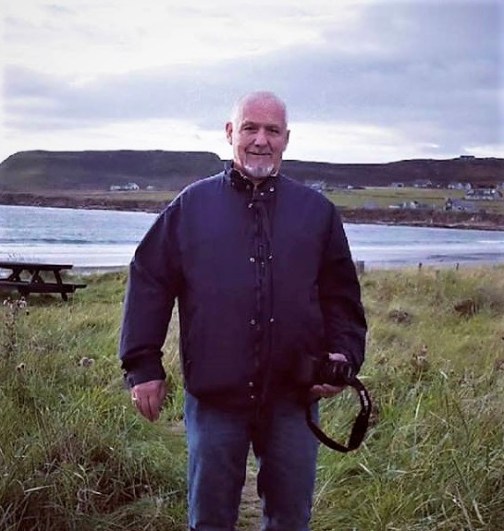
Guest Author: Paul White and Love

41530671_446651229159319_7854224569849085952_n - CopyWhen Noreen asked me to write a guest post for this blog, I was happy to oblige. However, I had no idea what I should write, until she suggested I write about the love, my love, of writing.

You see, Noreen picked upon a paragraph from a post from my own blog ‘Ramblings from a Writers Mind’, this is it…

In my heart of hearts, I believe the soul of the writer, the artist that lays within, is the greatest asset of all. No one can learn to write unwillingly; the writer must have love and passion above teaching and education.

A writer must want to write, above all else.

So, with the introduction over, I’ll wander through my thoughts about this subject as they come to mind.

***

Personally, I believe the passion for writing starts early in life when a child begins to compose stories, poems or simple essays.

My own first ‘published‘ work was a poem called ‘The Angel of Death’, which may seem a rather disturbing title for an eight-year-old boy to use, until you relate it to the Bible. Now, I am not a religious person, but back then, in 1966, the world was a very different place and religious studies in schools here in England were almost exclusively Christian.

At the tender age of eight, I was just beginning to understand the descriptive power of words and, even though I could not yet meld and mould them as a wordsmith, I still found their basic meanings influential.

The following is that poem, written by an eight-year-old me in 1966.

It is as basic and childish as one would expect but, looking back with the knowledge and understanding I now have, I can see what my teacher saw in the writing and why she insisted it is printed in the school’s annual magazine.

The Angle of Death

In Egypt, there was a quiet night.

But when the velvet sky turned grey,

A sword, gleaming, white,

And blood dripping.

A cry, a scream from every Egyptian house.

The sky turns back into starry velvet.

Sobs come from the Egyptian houses.

***

I think once the passion for writing gets a hold of you, once it is deeply buried under your skin, it is an affliction which stays with you for the rest of your life.

Is it an addiction?

Is it some sort of a hormone imbalance?

All types of weird answers can be found on the Internet.

Some claim the motivation is all about money. Others insist on fame and popularity. Still, others mention egotism.

All of us are different and, in all honesty, there are probably just as many reasons for writing as there are people on earth.

Some of us hope to win awards. Others want to influence people’s thinking, maybe by teaching, or to inspire or motivate.

But they all miss the point.

The passion, the love for writing in the first instance is something, I am certain, you are born with.

I do not think the individual reasons matter. The important thing is to discover the root for your own reasons, discover where your love began so you can use that strength, utilize it.

Never be frightened of revealing your passion through your writings.

***

The pursuit of the writing life through the love of the pen is nothing new.

Many people rise at the crack of dawn to write before going to their day job. Some burn the midnight oil and beyond, often watching the sunrise on a new day.

Anthony Trollope, the prolific and well-known Victorian novelist was, in the daytime, a post office clerk. As was Charles Bukowski and Franz Kafka worked for an insurance company.

These are a few authors we know of because they became famous, but there were, and still are, a thousand more writers who we will probably never know about, ones who wrote just as passionately and with just as much love for the written word.

In years to come, in the future, I may be one of those forgotten souls. But even that thought will not stop me writing because I have my own reasons, a reason I voiced once before in an old blog I used to have.


These are the words I posted on that blog.

But it’s just a dream, I guess.

I write to leave a trace of my being, however faint that may be.

I hope, or dream, at some point in the future, someone somewhere will dust off the cover of one of my books and open it. Turning the yellowing, fragile pages for the first time in a millennium.

As they read my words, they shall hear my voice echo through the centuries, be touched by my narrative. I wish them to become one with my story, lost in the world of fantasy and fiction which inhabited my mind generations before… Then, I would not have lived for nothing.

But it’s is just a dream, I guess.

***

I know I am not alone in the love of writing from the heart, from the soul, from the very epicentre of my being. Here are what some other writers express.

“My writing tools were my most precious belongings. My best quill pen was made from a raven’s feather . . . I was often so poor that I could not pay my mantua-maker, but I always invested in the best ink and parchment. I smoothed it with pumice stone till it was as white and fine as my own skin, ready to absorb the rapid scratching of my quill”

Kate Forsyth


“Writing is making love under a crescent moon: I see shadows of what’s to come, and it’s enough; I have faith in what I can’t see and it’s substantiated by a beginning, a climax, an ending. And if it’s an epic novel in hand, I watch the sunrise amid the twigs and dewing grass; the wordplay is what matters.

Simply put, I’m in love, and any inconvenience is merely an afterthought.

The sun tips the horizon; the manuscript is complete. The author, full of profound exhaustion, lays his stylus aside. His labour of love stretches before him, beautiful, content, sleeping until the next crescent moon stars the evening sky.”

Chila Woychik, On Being a Rat and Other Observations


Since I was a child, the only time I was really happy was when I was lost in the pages of a really good book. I loved everything about it. The print, the paper, the intricately designed covers. And most importantly the stories held between the covers. Books were an act of love. Nothing more. Some beautiful soul had taken time and effort to pour out their thoughts. Someone had taken the time to cultivate an entirely new experience for you to immerse in. Get lost in. Feel a sense of wonder in.

Sakshi Samtani, the writing cooperative.


I hope you enjoyed reading this post and that it has given you something in return for your efforts.

This is the link to my blog, Ramblings from a Writers Mind, https://ramblingsfromawritersmind.wordpress.com/

This one is for my website, http://bit.ly/paulswebsite  please come and visit, take your time browsing and say hello.

In the meanwhile, Keep Happy.

Paul White
head2 2.jpg

Writer Wednesday: Sharing is….?

climbing helping  team work , success conceptIn a writer’s group, I asked a specific person how one would use a certain program. They responded with, “I’d be glad to show you; my rates are very reasonable.”
I was shocked into silence. I asked a simple question, and they wanted to charge me for their answer?

But, then again, they have the right to earn a living by selling their knowledge.

How often have I given my knowledge for free? I could charge, I thought, for all the information and skills I’ve accumulated over the years.

But – wait a minute – writers really don’t make that much money, and we’re all strugglingshare3 in the same boat of trying to get our books, articles, short stories, or other out there to larger audiences.

Think of being on a life-raft and you are the one who has the clean water, or maybe the secret to cleaning the water, would you really sell it to another passenger? Some people would.

There’s a story from a Gladwell book about how post-its came about. (To simplify:) One worker in the paper department bumped into someone from their glue department, they both talked about what they were working on and the problems there were having. If only we could….   and boom – two collaborators came up with an idea worked together to bring that to fruition by sharing their expertise and invented something we all use (and made billions for 3M!).  Companies like 3M, Apple, Google, and others now use that theory to come up with new ideas, products, and solutions for every day problems!

shareWhen we all work together, we all become better humans. I want to share my ideas and experiences and share other writer’s with you, other ideas with everyone who desires to listen.

I have a job; I have many jobs. I’m not about to take advantage of others who are students in life or in writing and try to make a buck from them. I’d rather share my knowledge. I’d rather help my fellow passengers on this journey.

Thanks to all who have shared their knowledge with me. Thank you to those writers who give of themselves and their resources to make a better writing community.

When we work together, we can all benefit.

share1

Friday Feature: Waiting is NOT the hardest part….

I’d hate to disagree with our dearly departed master musician, Tom Petty, but the waiting is not the hardest part – That’s a myth.

waiting2Waiting is the easy part.

If I haven’t lost you yet, let me explain.

Some people spend their lives waiting. They dream of doing more, but they create excuses of why they can’t or why they haven’t yet. They’re waiting for…. fill in the blank…. the right time, the right place, until they finish this, until that happens.  It’s an excuse.

When you’ve moved forward and accomplished something, the waiting becomes the easy part.


The hardest part is jumping over every damn hurdle that life puts in front of you.

The hardest part is avoiding those people who want to limit you.

The hardest part is not buying into the self doubt that holds many people back.

The hardest part is doing the work. And then doing more work.

The hardest party is putting yourself out there and face the possible criticism.

The hardest part is never giving up.

Magnifying Glass - Action


Rejection is not the hardest part – it’s just part of the whole. The whole world is not going to love everything we do.

Waiting for the results is not the hardest part – that’s part of the whole.

Motivation or inspiration is not the hardest part – not even sure that’s part of the whole, but it helps.


Action is what is required to be successful.

Sometimes, action makes others around you uncomfortable. They’ll try to criticize your forward movement as wrong action. I can’t tell you how many times people have harped on something I’ve done as if I’ve ruined my chances at success, when in fact it was a step in the right direction.

I’m unclear if it’s a fear of rejection or the fear of success itself that keeps people stagnated in excuses. If they become successful, their lives will have to change. They’d have to continue to work, to duplicate their success.

waiting5I consider it is not a fear of failure – because, by not trying, aren’t they failures already? Or maybe that’s it – they can claim they never “got their chance,” when, in fact, they never actually took a chance. That’s the true failure.

Success follows action. Action takes work. As long as their is forward movement, there is no failure. As long as one doesn’t quit, doesn’t give up, there is no failure.

Don’t wait. Move forward. Slowly. Consistently. Misstep and get up again. Keep moving forward.


Friday Feature: The Overlooked, The Forgotten, The Displaced: Unbridled Inspirations – By Dianna Brown


Close your eyes for a few seconds and think of the word ‘inspiration.’ inspirationWhat comes to mind? Are there images of magnificent places you’ve been, impressive people you’ve met, or extravagant stories that stimulates your soul, sparks your imagination and almost brings you to tears? These everyday inspirations lead me to be the best version of myself, however, this is not a source of inspiration for my writing.

What if I told you my writing inspiration is in the overlooked, the forgotten and the displaced? I see potential in the bleakness of a shadow. I take interest in peculiar sights. I notice the unnoticed. My desire to write stems from the stories that are cut short. Not just unrequited love stories, but stories attached to the abandoned—whether objects, people or places. I am intrigued by ghost towns, and the remnants of memories left behind.

Sometimes inspiration comes from one word. I have a fascination and love of words. Maybe it’s a name, a word I overhear in conversation, or one that stands out while I’m reading. To me, words hold weight and are springboards for the fine details of characters, setting and, sometimes, plot. I call these words, triggers. One word triggers a plethora of infinite possibilities. Couple this with an innate curiosity about the little things in life and inspiration calls out from every direction.

Inspiration also comes from pain. Writing is a resiliency of spirit. It provides an avenue to unleash hurt by navigating emotions through an alignment of fictitious stories. I also believe the act of writing is an acute desire to heal. This is true for reading as well, as there is nothing more enjoyable than being whisked away in the transfixation of a book.

I wonder sometimes if writing is a window into the subconscious. Much of what I write is not intentionally thought about, but comes out in a stream of consciousness that can surprise me. In dreams, I hear the music of the most haunting melodies and poetic lyrics. In the middle of the night you can find me scribbling what I remember by the light of my phone, blurry-eyed. Unfortunately, in the morning the indecipherable lines can never match the beauty of my dreams. Words that enter my mind are often ones I’ve never heard of before, and after I’ve written my word count goal, I will look up the definition of the word, to find it fits perfectly with the meaning of the sentence. Although it’s likely words stored in my subconscious, that I’ve encountered somewhere along the way, it shocks me nonetheless.

When I wrote the novel ‘Saltwater Joys’ I had inspirations from childhood memories of oral Newfoundland folktales and ghost stories—ones I still love to hear again and again. I explored these memories and extended the stories into what might have been, had the story taken a different turn. It is like a scavenger hunt in my mind. One idea gives me a clue to where I might go with the story or character next. Other inspirations for this literary fiction novel came from the works of Edgar Allan Poe, as well as many classic tales and poems that made me see the unimaginably intricate, and sometimes horrific, connections in life.

inspiration2I like to explore the darker sides of life, which is interesting to me because I am naturally a good humoured optimistic individual. There are an unbounding instances of inspirational dualities in life, the play between light and dark, life and death, vice and virtue, and I realize as a writer I am one of them.

Dianna Brown’s Website


~~~~~~~~~~~~~~~~~~~~~~~~~~~~~~~~~~~~~~~~~~~~~~~

Thanks, Dianna.

noreen

Writer Wednesday: Life Awry

karmaSometimes, I wish I was the driver of the Karma truck. But, I suppose, being a writer is better. Still have the problem of sitting too long, but we get to exact revenge too. The best kind of revenge – in print.

Many years ago, sharing some big life altering event with a friend, she responded, “I guess these things happen to you because you’re a writer.”

Of course, life awry, I didn’t think this is the best response a friend could give – but, then again, maybe it was. Because it’s true.

What writer hasn’t written the demise of someone who’s wronged them? karma2

We writers have a way of writing life into our fiction. We work out our demons, our personal challenges, and by putting it out there in our fiction (or even in our creative nonfiction), we do one better than reap revenge, we are relieved and we are relatable to others who have gone through similar situations or similar emotional upheavals.

Recently, my life became vexed by a certain set of people and circumstances which caused great stress and loss (how’s that for vague?); and true to form, one of my writer friends said, “sounds like a great book!”

It damn well does.

karma4But, first, I had to roll my eyes and throw back my head. I just wanted some sympathy, some empathy. But she gave me more than that – she gave me purpose, building from ashes, and a way for me to transmit sympathy to another by relating to a scenario which many of us have experienced.  (I know, still too vague.)

However, the tragedy still fresh and the skin still tender, I’ve written on outline and will start on the book when the callous scars over and the sensitivity has dulled.

Friday Feature: Snowflakes in a Blizzard, Darrel Laurant’s Project to Assist Writers

Darrel Laurant contacted me some time ago about featuring my book, West End, on his project website. I’m only happy to now have him talk about that project here.

~~~~~~~~~~~~~~~~~~~~~~~~~~~~~~~~~~~~~~~~~~~~~

PlainNegligibleGrebe-size_restricted.gif


Completing and publishing a book — any book — is a noble accomplishment. Unfortunately, it’s only half the battle.

Writing, publishing and marketing used to be co-joined triplets, or at least close cousins. Now, though, they have drifted apart into separate entities. As a consequence, the new mantra from publishers turning down a manuscript has become: “We really like your book, but we don’t think we can sell it.”

What you realize, as you skim over the Top 100 best-selling offerings on Amazon or even the hallowed New York Times list, is that “marketability” now has very little to do with what we used to perceive as “quality.” Not that a well-written book can’t be successful, but writing well is no longer a crucial requirement, writing not-so-well no longer a deal-breaker.

The good news is, thanks to current technology and increased self publishing options, almost anyone who really wants to get a book published can now do so. The bad news is, almost anyone who really wants to get a book published can now do so.

The fact that 30 million or so books are now listed on Amazon has drastically changed the rules of engagement. The issue is no longer getting published, but getting noticed.

Writers are obviously the losers in this not-so-brave new world, but so are readers. Books go surging past us like flotsam on a flood-swollen river, never to be seen again. If it was published in 2016, it has already become a relic.

The idea of Snowflakes in a Blizzard, which started three years ago, is to become just one small voice shouting: “Whoa!”

I spent more than 30 years as a newspaper reporter and columnist, wrote a lot for magazines and Websites on the side, published two books that sold over 3,000 copies each locally, and won a lot of writing awards from the Virginia Press Association.

In some occupations, all that would have helped ease my transition when I retired from journalism to write books full-time. In the publishing field, I had to check it all at the door.

When my first novel, “The Kudzu Kid,” went up on Amazon, I was excited. I now had my own little niche, exposed to the world. I had a publisher who, at least in theory, was prepared to spread the word. I had a distributor to transport my books to the far corners of the nation. Smiling contentedly, I sat back and waited for the orders to pour in.

And waited. And waited. Eventually, it dawned on me that since nobody outside of Central Virginia had ever heard of me, the odds of anyone randomly clicking on my Amazon page were infinitesimal. Why would they?

At some point during the mini-funk that followed, aggravated by the winter blahs, I was standing in front of my living room widow in Lake George, NY, watching it snow, when this thought occurred to me: “Getting noticed for a new writer these days is like a snowflake trying to stand out in a blizzard.”

A few months later, I started the Snowflakes in a Blizzard blog.

Each week, Snowflakes highlights three books. They could be novels, poetry, short stories, non-fiction, memoirs or a hybrid. What they have in common are that they are a) unique in some way and b) could use more attention. The “template” for every book is filled out by the author and goes individually to each of our 3,000-plus followers, complete with a few reviews and a sample chapter. It’s a way of getting one-on-one attention.

Also, it’s completely free. I like that for several reasons:

First, it takes the pressure off. Charging for a service is all about making a promise — in this case, pay me and I’ll sell books for you.  I can’t do that, because I have no way of tracking who might have purchased a book because of a Snowflakes post they received.

Second, it makes for a better vibe between me and other writers. They are colleagues, not customers.

Finally, I don’t feel competitive with any other writer-friendly blogs or Websites. In fact, I’d be delighted if a thousand other sites sprang up just like Snowflakes in a Blizzard, because that would still not take care of all the writers who need such a service.

You may have heard it said that the opposite of love is not hate, but indifference. In the case of the book-buying public, the enemy is our very human tendency to stick with what we know. Early in our lives, most of us have settled in on what food, music, movies and, yes, books we like.

This fact unquestionably drives the book publishing business. It has become a lot like politics — survey the public to find out what they think they want, then give it to them. It accounts for the focus on genres, the reliance on best-seller lists and the dicotomy of wealth between the top one percent of authors and everybody else.

I don’t like to point fingers at the publishing industry, because they need sales to survive. So do agents. I do, however, think that the current glut of books has contributed in many cases to tunnel vision and laziness. What used to be “Wow, this is a great book — we need to tell people about this talented new author,” has morphed into “Oh, too bad — it doesn’t have the right genre for our demographic.”

This genre fixation is one of my major gripes about the book business today. Instead of offering unique work that only they could produce, some authors are “writing to genre,” following a list of pre-prescribed rules in an effort to “fit.” Yet so many of the books that made a big impact upon arrival — think “In Cold Blood,” “The Color Purple,” “To Kill a Mockingbird,” “Roots” — probably would have flunked the genre test.

To their credit, a lot of small “indie” publishers do seek out and nurture talented new writers. Sometimes, they are richly rewarded for it.

My other gripe is the attitude held by some gatekeepers that they are doing writers a huge favor by publishing them. I growl, internally, every time I see this on a Website: “If you don’t hear from us in two months, it means we’re not interested.”

How much time and trouble would it take to type “Thanks, but not for us,” and hit “send”? Or maybe, “We’re thinking about it.”

This lack of communication shows a naked disrespect to authors who, after all, just want to enter into a business deal with them. Think of how you’d feel if you walked into a restaurant, sat down at a table, and were then ignored for an hour before you finally got up and left.

OK, so the creative universe is awash with other books. Publishers and agents can be uncaring, potential book buyers unlikely to try something new, both realities especially hard on new writers who haven’t yet accumulated prior publications, lots of good reviews or a book club fan base.

So what can we do? I make no claims of being an expert (I’ve never had a best selling book, so what do I know?), but I do have some suggestions.

  1. Look at the myriad niches that might be hidden beneath the main thrust of your book. These could include the setting, the occupation of main characters, a societal issue that is addressed, etc. Find some on-line clusters of people who reflect those nooks and crannies and send them a sample chapter. Do everything you can to show a publisher or agent that your book will, indeed, have a ready-made audience.
  2. Don’t forget the local connection. After your book is published (or even before), show up at your local newspaper office, meet the book editor, and suggest a review of your book. Don’t forget the little free papers than have mushroomed everywhere.
  3. Arrange similar meetings with small bookstore owners in your area.
  4. Set up as many book signings as you can handle, including businesses other than bookstores.

I invite you to check out the Snowflakes in a Blizzard site, and perhaps even follow it. Or, you may have a book you’d like to have featured, or know someone else who does.

My e-mail address is writersbridge@hotmail.com, and I love to talk about writing, any time.

~~~~~~~~~~~~~~~~~~~~~~~~~~~~~~~~~~~~
Much luck, Darrell. Thanks!
noreen

Friday Feature: Valerie Cooper and Finding Writing Time

I’m more familiar with Valerie Cooper’s poetry, as we’ve both appeared in Delphinium Literary Magazine. So when she contacted me about writing a piece about finding time, I thought she’d have something important to say. We’re both single parents, except mine are now grown, which gives me more time. Hers is still quite young – and as I once did – she searches for little bits of time to write.

~~~~~~~~~~~~~~~~~~~~~~~~~~~~~~~~~~~~~~~~

vcooper1As a single parent, writing can be difficult. I’m required to be creative and write around my daughter’s schedule. I find time in the mornings, for twenty or thirty minutes, before I get her up for pre-school. At work, I take five minutes here and there when I can to make notes or outline an idea or twElise Climbing Rocks in Central Park NYCo. I get another hour, if I’m not too tired, after I read her stories and put her to sleep.


I know my friends who don’t have kids have more time than I. But, also, my friends who don’t have kids aren’t as focused as I am on being successful. Children take a lot of your time, much of your energy, but what you receive in return is far more satisfying than much else life has to offer. My daughter inspires me to work harder, to be successful. Before her, I thought, “I’ll get there some day.” But after she was born and I looked into those big, beautiful eyes, it lit a fire under me!

Many writers complain about not enough writing time. Life is busy and messy. We need to work around it. So sometimes I get up early. Other times, I stay up late. I get creative and grab what might be otherwise wasted moments.

vcooper3I write poetry in the park on warm Saturday afternoons while the children are screaming with joy on the climbing gym. I write lyrics in the parking lot, in the chilled air of my car, waiting for pre-school to end. I outline a story over the humid stove, while my daughter waits impatiently at the dining room table, chomping on carrots.
There is time, it just comes in increments, joyfully swinging around everything else in your life. It’s there. You just have to grasp it.

Valerie Cooper

Delphinium

The Kiss

~~~~~~~~~~~~~~~~~~~~~~~~~~~~~~~~~~~~~~~~~~~~~~

Thanks, Valerie. Much Luck!

For everyone else, I suggest one of these!

vcooper5

Writer Wednesday: Critique Partners – a little bit of heaven!

Some years ago, I belonged to a critique group. critique-3-300x225Of the four writers, none had been published and I became the only one who expressed specific goals. In one session, a women writer spent the whole time helping another writer without responding to the rest of us. It sometimes happened, so we weren’t offended; but the following week, the same woman spent two minutes on mine and said something to the effect, “I don’t even know what to tell you with this…” before moving to another person. I realized I was wasting my time there.

Years after that, at a meeting, I sat next to a colleague I barely knew. She mentioned she was a writer, and we soon struck up a friendship and critique partnership.

critiqueWe’d meet once a week or once every other week to read and review each other’s work. Timing and responses began bumpy but smoothed out rather quickly. We were near the same writing level, although I give her credit for being better than I. As we got to know one another, we understood what the other was attempting to accomplish in their own fiction. This helped us read one another’s work more productively.

The most important elements in a critique partnership is respecting the other, giving honest opinions without being brutal, and accepting criticism. As professionals, we didn’t experience issues in offering or receiving the feedback. At some points, we may have disagreed, but we didn’t let it interrupt what had (and has) become a successful venture.

My writing has vastly improved because of this partnership. I benefited from the critique1authentic and detailed critiques with increased confidence, which lead me to more submissions, and ultimately more publications.


How you might form a successful alliance:

  • A mutual understanding of writing goals and aesthetics.
  • Similar level of writing experience (or someone who has more than you. You want to grow from this experience and you’ll have a chance to give back.)
  • Trust & honesty – go hand in hand.
  • Time and availability to meet or exchange work.
  • Although it may help if you write in the same genre, it’s not required.


For those of you who have partners or experiences, did I miss anything?

critique4

Friday Feature: Submissions

This week for the friday feature, I thought I’d offer tips on Submitting.

Last year, I had 17 or 18 publications. This year so far, I’ve had maybe 9 or 10 acceptances. I must be doing something right.  submissions-photo-01

I think it should go without saying your work should be free of grammar and punctuation errors. I heard from one writer who was offended by an editor; her response: “I know I had errors, but they weren’t that bad.” – No excuses. Edit that work before you send it out.

First: Make a regular time to sit down to submit. This takes HOURS. It’s not going to be just a fifteen minute or thirty minute venture. You must read what the lit mags are looking for as well as how they want it submitted. Then compare it to what you might have already written, or what you’re willing to write.

Second: Keep track of your submissions. submissions1

Third: Accept rejection. (It tells me that I’m doing my job by submitting.)

Fourth: Accept criticism. You are going to get opinions. Just today, I received a rejection that said I repeated a word. That was the whole of their rejection. The word in question was repeated twice in the whole story, but I guess they didn’t like it. I moved on.

Fifth: If they ask for changes – agree (maybe). I’ve met many writers who take issue withsubmission this. They wonder if I don’t care about my work. They think I’m mad for even considering it. There are some things I won’t change. But, so far, the editors who have asked for changes have asked for simple things like rewrite this sentence, change this punctuation. No one has asked me to make major changes to any piece I love.


And Finally: Be considerate to writers, editors, and publishers in emails, on public sites, and anywhere you may meet them. When you act inappropriately, word can get around.

Publications Page

Amazon Page

submit

Writer Wednesday: Experience Vs. Research

Someone asked me if I write what I know. For many, that would be limiting. We write what we know in some intuitive way, like people, emotions, relationships, and some places. But that’s not all we write.catacombs

Nothing adds to a story like those little details that you’ve experienced, like the slick, moist, near sickly feel of your skin on a humid day in Paris after emerging from the chilled underground of the catacombs.

The difference in squeezing the smooth texture of black sand from Punaluʻu Beach in Hawaii between your toes and walking on fine, compacted white sand of the Whitsunday Islands in Australia.

blacksandEvery beach is just a little different. Just as the light is, depending where on the planet you stand. Being there helps.

But, research is also necessary. Maybe not to describe the sand between your toes, but other important details about place. Incorporating the general details or impressions as well as the smaller, more personal elements creates a more vibrant and more relatable to readers.

Stephen King thanked his research assistant and stated he met a lot of nice people in Oklahoma where his new book, The Outsider, is set. Experience and research.

Many of us can’t fly to Darrien, Washington and spend a week or longer researching a small town setting in the pacific northwest, but we are able to view maps, read the newspaper, follow the instagram sites, ask travel groups and even call the travel bureau in any given state.wander.jpg

I love experiences – Traveling and getting lost in a new place, picking up those sensual memories to infuse into writing and future!

Experience is a great thing, but it’s not the only thing. Research back ups and fills out details we may have missed.

Where have you been that you’ve written about?

Happy Writing!