Writer Wednesday: Say Yes to the Edit….

When I’ve mentioned, within a writer’s group, an editor asked for changes the room heats with disagreement.

writerblog2


“You’re not going to do it, are you?”

“Why would you sell yourself like that?”

“How dare they?!”


They dare because they are willing to publish my work; and while it does matter what they ask, I’m willing to listen and consider their ideas and advice. Usually, it is merely for clarifications or changes in simple sentence structure or the like.

My story, $1.00 Stories, was originally published by the Chicano Tribune’s Printers Row Journal. When that editor called me and hesitantly said, “we’re requesting changes;” I think he was quite surprised with my, “certainly.” The only requested was a few clarifications between the character’s name, Chris, and his nickname, C.C.

writerblog3It would be foolhardy and, even, unprofessional for me to say no without hearing them out.

While I suppose many writers believe the editor might ask for major changes in ideas or plot, I haven’t had any ask me for such things. As writers, we need to be open to consider what is said.

By request, I critiqued another writer’s work. I offered my point of view, and they became offended, tried to explain what they meant in this scene or that narration. My response, “there are all great ideas, but they are not in there.” The young person huffed off, I believe, without hearing me. Writers, we cannot be that sensitive.

We are not perfect human beings. We make errors. Some things are clear to us, but not to others. We can improve our work for the better by listening to others’ opinions. Of course, not all are worth considering. But an editor’s opinion, one who is willing to publish your work, is valuable.


writerblog1

Friday Feature: Guest Author Margie Harding.

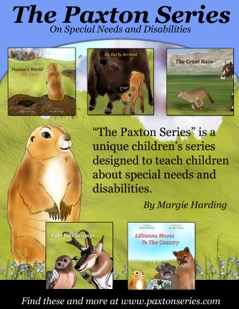
I wanted to start something new and feature other opinions, ideas, and authors on Fridays. Today, I’d like to introduce you to Margie Harding, author of The Paxton Series.

~~~~~~~~~~~~~~~~~~~~~~~~~~~~~~~~~~~~~~~

Writing is a passion I’ve been developing for many years.  While I blog, have written devotionals for teen girls, a novel about my experience of attending college as a non-traditional student thirty years after high school graduation (receiving an AA degree in Elementary Education), and more; I have been provided yet another challenge that warms my heart.

For years I have said, “It takes a special person to be a special education teacher and it isn’t me!”  I have five children and sixteen grandchildren and still a special education interest alluded me!  It was never my heart’s desire.  God has a sense of humor, I think.  After all these years of avoiding special needs and disabilities, I have begun a new children’s book series on this particular subject!

We call the series, “The Paxton Series” with our setting in the Black Hills of South Dakota, paxtonusing the wild animals of the area as our characters.  (Paxton the Prairie Dog shows up in every book, if nothing more than in a cameo appearance!)  The books are written for the child with the disability or special need….and for the child that asks, “What is wrong with my friend?” —and there are amazing illustrations, thankfully from someone who is able to acclimate the disability to the particular animal!

When the series started, I had no intention of a “disability series,” yet it morphed into this before I’d realized the need for this kind of material or impact it could make.  I attended a church organized disability conference two years ago and for the first time heard the term “disability people group” and learned much about these special people for whom I was writing!  The statistics astounded me!  I knew this was to be my life’s mission.

I am delighted to say this series is being well received –and will continue indefinitely! (The list is up to 60+).  Doors have opened I never imagined as schools, colleges (using them to teach students to be special needs educators) and other groups have found the merit of sharing these books with children, parents, educators, medical staff and others!

Invitations to share about the books from a “special needs” perspective, have also arisen and I am delighted to be an advocate for these children (and adults) who are often neglected in a variety of areas, (even if unintentionally) including written stories they can relate to.

There is very little actual reading material for children who have special needs; and paxton2certainly not for those young ones introduced to special needs children, as integration into mainstream classrooms continue.  Their peers are often confused by what they see as “different” and perhaps even “wrong” when it can’t be defined by the “normal classroom rules.”  My books attempt to bridge that gap, and are a great starting place for teachers.  They are written to aid in understanding, inclusion, and acceptance of those behaviors that are different from the traditional “norm.”

There are ten books in the series currently.

Paxton’s World on Fire                                                          Introduction

An Early Arrival                                                                     Preemie

The Great Race                                                                       Asthma

Ears Like Gramps                                                                   Hearing

Lillianna Moves to the Country                                              Down’s Syndrome

Micah Mink Goes to the Concert                                           Autism

Mixed Up Words                                                                    Dyslexia

Special Goalie                                                                        MD

Opal’s New Dream                                                                 Arthritis

The Camping Trip                                                                 ADHD


Coming soon:

The Spelling Bee                                                                    Diabetes   (September)

Madison’s Sad Christmas                                                       Depression (November)

Bristol Goes To School                                                          Cancer      (2019)

Harbinger Village                                                                   Cerebral Palsy     (2019)

Fabian’s Smile                                                                        Cleft Palate            (2019)

Our children face an amazing list of challenges.  God has placed me in a position to be able to do something fundamentally good.  I am humbled to be able to place words on paper that can help children understand what is going on in their bodies, as well as, a resource parents and teachers can use to help other children understand what is happening with their friends who seem different than themselves. If you are interested in any of these books or those to be released in the coming months and years, contact me, authormargieharding@gmail.com or visit http://www.paxtonseries.com or amazon.com.

**An added note — All 10 books are both in softcover and hardback….and we are just beginning to add a toddler version of the current K-3rd grade books (although the books are used for older students in special education classes, as well), and I am working on a chapter book!  The first toddler book, The Big Fire, should be available in just a couple weeks.


~~~~~~~~~~~~~~~~~~~~~~~~~~~~~~~

Margie – thank you for guesting. I’m grateful I could host your blog and further the word about these important books.  NL


Writer Wednesday: Writer and Writing is a Relationship

heartI know people say writing is a commitment, but it’s more than that. Writing isn’t “like” a relationship, it IS a relationship. A writer must be involved with the whole process of writing, must love it, need it, want to continue to work to make it better. It takes commitment, time, dedication, and the desire to move forward in life with writing.

A few years ago, I was at a conference where the main speaker (don’t remember his relat 1name) said, “You have to be selfish. You must take the time for yourself, for your writing.” He went on to say he spent every Friday at a hotel with his writing. (are you picturing him checking into a seedy, no-tell motel with an old typewriter?;-)

My friend joked, “Noreen does this thing where she actually spends time writing.” My regular action became fodder for humor because he is a writer, but he falls under the category of non-writing writers like many others.

Life happens. We have families, pets, jobs, homes, tons of responsibilities. But notice that list – I put family first. People we love comes first. This is why a writer might consider writing as a relationship – so they give it priority.

I schedule things around my writing whenever possible. I will make doctor appointments, meetings, and everything I have power to plan secondary to my writing by scheduling them before or after my planned writing time.

Once a person considers themselves in a relationship with their writing, they may relat 3naturally form relationship goals! If writing were a romantic relationship, how would you handle it differently? Would you want to go to sleep with it or wake up with it or both? What would you want to give it? Would you spend more time with it, going over the details, working it out so it was just perfect, going over it and over it again to work it out nice and smooth? What do you do for your significant other? Take it out to dinner? On vacation?

Writing, like a lover, needs constant attention and nourishment. Placing it on the back burner means we may never get to it. It’ll be there, but not as warm and flush as we’d like. Being in a relationship with writing means the needs of both are fulfilled. Writing is fresh and flowing and continually improved and the writer is happier, more productive.

We do this because we love it, we are driven to do it. Treat writing like it’s important to you.

Think of writing before you fall asleep, when you wake up in the middle of the night just to say one more thing.

relat 2

West End – the opening chapter

Hi, All.  I was feeling West End today. I wanted to share a little portion, but couldn’t decide, so I give you all the opening selection for West End.  Enjoy.

front-cover-small

BEFORE MY MOTHER drank herself to death, I knew her as a gentle creature who fed wild squirrels from her hand.  On the back patio at mid-day, she’d stand very still, calm, peanuts laced in the fingertips of her outstretched hand. The squirrel, a female, her babies came later, approached with caution, across the railing, onto the windowsill, grab the nut, run to the other side of the patio where the squirrel peeled back the shell, ate the meat, then returned for another and another. For a while, the squirrels became my mother’s greatest pleasure.

When the female squirrel stopped coming, my mother worried, but the baby squirrels continued to visit. Then, the cubs must have grown, left the nest, because one by one they disappeared until only a single squirrel came to the daily meeting.

That winter, mother’s heart sucked itself dry. Familiar faces appeared, distant relatives, long-ago friends, who talked our concerns away with assurances for tomorrow and beyond.

“Little honeys, it will be okay.”

“I brought the eggplant casserole, green dish.”

“She was a wonderful woman.”

“Call if you need anything.”

Sarah and I stood at the door where someone’s aunt told us to stand. We pointed people who carried in food to the kitchen, guided people with flowers to the dining room, pointed the rest to Daddy who sat on the couch, gaze glued to the floor. We didn’t have to say anything, and no one asked.

The familiar strangers came and went and with them, our mother, our hopeless youth, our language.

The house became quiet. I couldn’t remember the last complete sentence I spoke or heard, couldn’t remember the last partial sentence I’d said to my father or he to me. My sister and I exchanged words, hushed, sometimes soundless breaths only we knew the meanings for. We lived our lives in half-words, pale sounds that sunk into the silence, in ideas of what we had to do next: breakfast, school, homework, laundry, dinner, dishes, bed. This soundless process became our lives; a strange off-balance way to live, but we did it for some months content not to break that pattern.

One cold February morning, a descending snowstorm blocked the roads, locked us indoors, kept us from going to school, our father from his work. Our first full day alone together in the house. Sarah and I sat at the painted brown kitchen nook picking at our cold Raisin Bran; the milk just tangy enough for us to question the freshness. A tapping noise brought our eyes to each other’s. Then silence.

“Wind.” Sarah exhaled with barely enough voice to make a sound much beyond the breath itself.

“Yeah.” My voice not much stronger. We returned to the cereal.

Tap…Tap…Tap…

Her gaze followed the floor to the sink, the counter, the back door.

“The door?”

I shook my head. “Nah.” Not today, at mid-day, in this storm. “Wind.”

I slipped from the nook; she followed. We stood, somewhat unnerved when the tapping came again. We could see through the glass in the door; no one stood there. I moved to the windows to get another view of the patio, leaned over, heard shuffling, then rattling against the window. We jumped. A squirrel clattered against the window, caused us both a momentary and laughable fright. Sarah touched my arm. We each took a deep breath. Our first that winter. The squirrel, the female or one of the children, we didn’t know and could never tell anyway, gave us a quizzical look, stretched up against the window; her little paws stretched against the glass. Tears welled. Quiet, unmoving, we held our breath, each other, tried not to let out the flow of emotions the winter built up.

Father’s footsteps, heavy on the linoleum, came toward us. We straightened.

“What’s going–”

“Shhh,” we both hushed him; his rough, dry voice might drive the squirrel away.

“It’s the squirrel,” Sarah said.

He looked puzzled.

She motioned toward the window. “The squirrels Mom used to feed. She used to give them nuts.”

“Well, give it some.” He waved his hands at us.

“Where are they?” Sarah pulled open random cabinet doors.

“I don’t know.” I opened the opposite cabinet doors.

“Well, look, look. They have to be here.” Father took to the drawers.

The three of us searched for a bag of peanuts Mother bought for the squirrels, hid from us to deter our snacking.

“He must be hungry.” Father gazed out the window at the back yard covered in snow. The porch railings, the powerlines, all draped in sheets of white; the squirrel, nervous, waited at the end of the banister. “Peanut butter. Get the peanut butter.”

“Will he eat that?” Sarah reached for the jar.

“Certainly,” Father assured us. “It’s peanuts, isn’t it?”

I grabbed for the bread.

“Just spread it on,” he said, more animated than I’d ever seen him.

We did.

“Wait, he can’t eat it like that Break it up.” He put his hands in the mess with ours.

Of course, we knew, but at the moment, that strange, unsettling, yet somehow comforting moment, we all needed to take part.

Sarah set the plate on the patio just outside the backdoor. The squirrel chattered, juddered its head from her to the door, the windows, its tail jerking back and forth as if with nervous jitters, then approached the plate, took a piece, and skittered back to the railing to eat it.

Dad ordered us away from the window. The little squirrel tittered, danced delicately, tail flitting, to take more food. We backed out of the kitchen.

Something shifted inside the house. The rooms warmed. The silence faded. The house took on old noises; the refrigerator hummed; the kitchen light buzzed; switches flicked with their old sticky clicks.

Our voices returned. We spoke more than mere sounds. We’d broached full sentences. But I don’t know if we ever surpassed that. We’d never been a family of paragraphs or stories. Laughter rarely rose to the ceiling. Now, with one of the speakers forever hushed, we were destined to be something less than complete.

Winter dissolved into spring; the strawberries mother planted last summer grew green, red, wild. We left nuts out all the time. Sometimes squirrels ate them; sometimes they’d sit until the birds got them or the ants swarmed them.

Sunrise reopened in summer, but never again did we hear our names called from the front patio as we walked up the street, never again did the light intonation of words follow us through the night, “not too late,” never again, upon our return, would we be met with a drunk asleep on the table with just enough consciousness to whisper “too late” when we passed through the kitchen to go to bed.


*West End is available on Amazon, Kindle, and Audible.
Coffee and your Character – Writer Wednesday

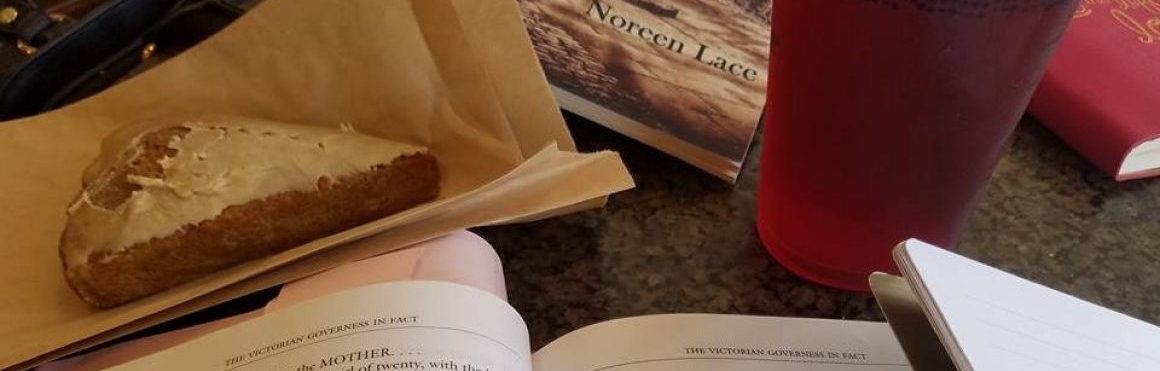
I’ve been thinking of coffee shops. And it’s not only because I’m a caffeine addict. Coffee and coffee shops are a part of our everyday lives and, therefore, our characters’ lives. What type of coffee shop and what they order will inform our readers of who they are in ways we won’t need to spell it out.

catwithstarbucks

I, personally, savor that first sip of morning tea. For a few moments, it’s the perfect temperature and I hold it close to my face, ready for the next sip as the first drips of bitter black tea warm my throat and my body, the caffeine going to work immediately to bring me to full wakefulness in anticipation of a busy day.

A friend described a man in her carpool who stopped every day at Starbucks for a large quadruple espresso latte on their way to work and on their drive back from work. But, she added, he also complained constantly about his budget. This told me a lot about the person in just a few sentences.

Does your character rush into Starbucks and curse the line? Probably orders ahead for pick up, but what if it’s not there? Or is your character the kind that seeks out the independent coffee shop because it may be less busy or just because it’s independent.

There used to be a coffee shop on Ventura Blvd between Hazeltine and Woodman. I don’t pinkremember the name, but I do remember the walls were pink. I liked it for it’s small town charm. Local home made jams lined the shelves behind me while local artists’ paintings adorned their walls. They only had a few wooden tables, a few more outside, and a few bar-type seats at the counter. Instead of the iced black or green tea choices at you-know-where, I opted for their daily choices, which might icled iced peach or raspberry-ginger. They offered an array of vegan or gluten free cookies as well. Who could resist?

I used this coffee shop in my story “Harvey Levin Can’t Die” (originally published in Pilcrow and Dagger Sept 2016). The story really is about change. How society reflects the harveylevincan't dieindividual and how the individual internalizes society. One of the characters worked there, but felt out of place. This also represented her life, she felt out of place and hadn’t really begun to make real decisions about who she was or what she wanted. But, of course, that changed and so did her involvement in the coffee shop and the guests as she becomes more proactive in her life. The reader is left to decide the interaction between her and society and whether the influence is good or bad.

It would have implied something different about my character if she’d worked at a chain coffee shop. The chain itself would have had an influence and been a foil. She wouldn’t have been able to grow and and the readers couldn’t see the change within the coffee shop itself; therefore, the setting was important in that instance.

Each place, each chain, is different. The people who go to the local Coffee Bean and Tea Leaf Company are different than those who go to Pete’s or even Starbucks. As writers, I imagine we’ve all spent time in these places. And our jobs as writers are to observe. Beyond the color scheme and coffee served, there’s a different atmosphere garnered by and at these places, and the people are different or act different.

I rarely see the impatient phone-bearing customers from the Monday morning Starbucks run at Pete’s. Nor do I see the more relaxed culture of the Pete’s “give me the multi-grain scone and flipped macchiato” at Coffee Bean.

1dollarstorysmashwordsI used another independent coffee shop for “$1.00 Stories” (originally published in The Chicago Tribune’s Printers Row Journal April – 2016). A mixture of independent coffee shops, one of which still squeaks by in the recesses of North Hollywood. I wanted a friendly owner and regulars my character would recognize. Not that he cared about them; it was more important for the story that they were familiar with Cris, and they accepted with good-natured-humor his occasional weirdness. I didn’t want to make him completely unlikable. I wanted him to come across as a little more complex, so he went to this coffee shop where he knew the owner and sneered at the community table while the regulars chuckled.

The joy I get from using independent coffee shops (or even invented coffee shops) is that I get to describe them, which will also tell us something about the character. In “Harvey Levin”, the character hated the pink walls. But using a chain also tells us something about the character.

Our characters are going to need caffeine at some point in the story. Giving the reader their choice of coffee shops, even in one line, gives the reader an insight into the person we’re creating.

Now my tea’s cold. But I don’t own a microwave and that never tastes good anyway.


Harvey Levin Can’t Die is available on Kindle and at Smashwords.

$1.00 Stories is available at Kindle and at Smashwords.


What’s New With You?

I’ve been remiss in my posting – which is a social media no-no.  icecreamCan I tell you a secret? I’m really just an introverted writer and I really want to do is:


Write!


Edgar_Allan_Poe_3


I had a fantastic time at the Poe Museum reading Eddy. They live streamed it (I didn’t know they were doing that!) and I’ve been invited back, hope to go soon!


27982653_1680480425366915_8840169907577678606_o

In the meantime, I’ll be at AWP.


But the real news today: my short stories – loving the covers! – are available for .99 cents on smashwords and kindle.


So – whenever you need something to do – click the link, read a story, let me know what you think!

Be Joyful!

Eddy – Win a Copy

Eddy, my new novella, will be out next month. I’ve eddycoverfinalbeen invited to read and speak at the Poe Museum’s Birthday celebration upon its release.

However, you can win a free copy before it’s released!

This is a fictional account of an actual event in Edgar Allan Poe’s Life. In 1848, whether accidental or purposeful, Edgar took an overdose of Laudanum, which was an opiate based medicine available on the open market. It was sold in pharmacies as well as pubs!

Poe nearly died as a result. This is a fictional imagining of that experience.

Poe reimagines the life and death of each of the women he loved. The story begins and ends in the Boston rooming house in which Poe found himself in November 1848 right after he’s bought the Laudanum. His overdose rouses images of his mother backstage at the theater in Richmond during her last performance  and continues on to Virginia in their Philadelphia home while she played the piano for their guests. The story doesn’t neglect his other loves.

Debbie the events coordinator from the Poe Museum said she was “blown away” and couldn’t wait to share it with her colleagues.

Eddy won’t be available until January 6th. But you can WIN a advanced copy by entering your email address.  You don’t need to enter more than once, your email address is your entry. A single one will be randomly selected by a generator, and the winner will be notified by email on or about January 5th.

darktimes


If you need more to whet your appetite, take a look at my interview with Super News Live on their Dark Mysteries Show about The Mysterious Death of Edgar Allan Poe.

I’m excited about releasing this as Poe’s work and life has been such an inspiration, not only to me but to many. His work will continue to inspire writers, artists, and film makers for many years to come.


EnJOY!

Not Writing is Not an Option: Rethinking Writer’s Block

I’ve been under the impression that writer’s block was actually procrastination; however, someone wrote recently “whoever doesn’t believe in writer’s block has never experienced the sheer frustration it can cause.”

This, and the comments that followed, made me reconsider my position on writer’s block.

Experts state that very few people actually experience the psychological issues that cause real writer’s block. That statement, and my observations of procrastination in action, have lead me to believe that most people who say they suffer from writer’s block aren’t actually suffering from deep mental disturbances but of more common problems that plague us all – distractions.

However, the advice this person received caused me to pause:

“Drink heavily.”

“Don’t force yourself to write, it’ll come.”

These seemed the least helpful. While I know there’s a stereotype that follows artists and writers – the best ones suffer, and suffer from addiction in many forms. I doubt very seriously whether getting drunk will help the person. And, if you don’t write at all, how will anything come?

Other advice went something like this:

“Just write.”

To which one person wrote a long response about the ridiculousness of this answer. I, however, disagree. When asked by my students “what if you get stuck on a part?” I answered, I go on to a different part, or I write something else. I usually have more than one project going at the same time. I know some writers don’t do this, and I understand their reasoning. At this point, it works for me.

“Go for a walk, do yoga, meditate.”

This is actually pretty good advice. Studies show going for a walk or exercise in any form can feed creativity. Yoga is meant to calm the energy in the body so one can focus and/or meditate.

Others said, “listen to music” or “write a character study.”

This could help. While writing one novel, I listened to blues and jazz to help me give the character depth and personality.

Finally, someone asked the person who’d posted they had writer’s block and needed a solution: “What’s bothering you?”

Now, that’s a damn good question. Most of my writer’s procrastination comes when some thing is bothering me.

The person’s answer was different than I expected.

“I can’t make the story go where I want it to go.”

OOOOHHHHH!

This is a whole different type of problem. I learned writing in two ways. One method was to write a formulaic story with beginning, middle, and the end in mind. Use an outline and stick to it. And I can do this. But it’s no fun for me. The second way I learned was to just write and see where the story wants to go or needs to go. Most of my writing comes this way. It’s natural, it’s organic, it’s unforced; maybe that’s why it flows.

Think of how much power water has. Human-made streams run over their banks, create their own pathways; in one way or another, they defy the path man made. Think of how much concrete and lead it takes to build a retaining wall to create a dam, and still they must have holes or release valves. How many still end up crumbling, breaking, or overflowing?

That’s what writing should be.

Ideas and words should flow. Let them live. Trust them. Trust yourself.

If they are dammed up, forced into an unreasonable plot or direction, then I can understand that type of writer’s block.

The advice offered for that was: “write the end, and work backward,” and “move on to another scene.”

This should probably work if the plot of the story is strong and the elements are all in place. However, the person maybe be stuck because a needed plot point is absent.

Before any solutions can be offered, the type of “block” the writer is facing must be addressed.  Is it really, “I’m stuck,” or is it “I’m distracted”? If there’s a phone in front of you, and facebook, twitter, or your blog open while you’re writing – that’s probably writer’s distraction. If the writer is stuck at a plot point, at a character arc, I’d suggest to meditate on it, sleep with it, think about it until it works itself out, but I also suggest skip ahead, write another scene, write that scene/character you tell yourself you’ll never use.

See – it’s still writing. NOT WRITING IS NOT AN OPTION. No one ever got better at something by NOT doing it. No one ever finished a project by not doing it. No one ever became successful by stopping what they were doing.


Goals & Accomplishment

goals

I know many people don’t start think about goal setting for another four weeks, but I consider it year ’round.

I don’t want until January 1st to begin anything, except a new year. I don’t make resolutions that I don’t keep, I rarely make resolutions at all.  When I want to start something new, whether it be health, wealth, a writing, I do it right away.

So – I’m not going to talk about what I’m going to do four weeks from now, but what I did 10 or 11 months ago.  In January of last year (not January 1, I think it was near the end of the month,) I made a vision board of what I wanted to see in my life. I’d never made one before.  I won’t bore you with all the things I placed on it, just a few things that did actually come to me throughout the year.

Of course, I had writing and publishing goals. I didn’t have a set number of publications or a set number of hours spent writing; those I set more often than yearly. eighteenHowever, by continuing to work on those writing and publishing goals, I’ve succeeded in publishing EIGHTEEN times this year.  18!  18 poems, short stories, books, etc floating around out there in the world!


I received these four complimentary copies in one week!

books.png


What Lies Beneath features a poem “UnWalden Pond.”
Vine Leaves has two poems: “The Fly” and “After.”
Wild Women’s Medicine Circle a narrative poem, “H.”
Delphinium published “Hope.”


Elsewhere on the vision board, I had things like book signings and talk shows and other personal things, some of which happened, some of which have not YET.

One of the things I included was an interview.  I’ve done two in the last month, but I did a live on air interview with darktimes.png

Super News Live on their show Dark Times in June. They gave me about 24 hours’ notice!  But

it was so much fun. The members of the crew and staff were very sweet!


Our brains like Goal Setting! Even setting little goals and crossing them off our lists makes us feel like we’ve accomplished something.

With my vision board, I didn’t actively cross anything off.  In fact, at some points, I forgot I’d had things on it. I looked at it after my Poe interview and realized – I had a picture of LIVE interview on it!!

I haven’t set goals for next year – yet. I have set short term goals that I will reset and realign when needed.

Waiting for New Year’s to set goals is like planning for failure. Why wait? What can you do right now to accomplish what you want? What can you do in the next month to know what you want to accomplish next year? If you know what you want to work on – why not start now?

I think by having a list or a goal written down somewhere, picture or other form, encourages us to more actively pursue, perceive, maybe envision that goal and work to accomplish it.

Good Luck!