Friday Feature: Second Chance – Iuliana Foos

The second indulgence of our Friday Feature is Author Iuliana Foos’ personal story- Enjoy.

~~~~~~~~~~~~~~~~~~~~~~~~~~~~~~~~~~~~~~~~~~~~~~~~

iuliana

Thank you so much for hosting me today.

Born and raised in Bucharest, Romania, I had a childhood and upbringing different from what most people outside the country are accustomed to. Since an early age, I loved to read. Growing up in a communist country, where all information was closely supervised, I soon ran out of book to read.

I had to start of course with the literature mandatory in school, all Romanian authors, but soon, I started to borrow books from my parents’ collection. When most people hear ‘Black Market’ they think of illegal merchandise. For us, was also books. Coming across translated international authors, wasn’t easy, but not impossible either.

It was when I fell in love with ‘The Three Musketeers’ by Alexander Dumas, the first romance book I ever read. I was only in my early to teens, so extremely impressionable. Until today I still believe everyone should have at least one sword, even if only for decorative purposes.

When I attempted to read ‘War and Peace’ by Fyodor Dostoyevsky, I failed miserably, falling asleep before finishing a whole page. I still didn’t get the courage to go back and try to read what at that time, for me, was the most boring book, so I never made it past the first chapter. It served as a good paperweight, and many times I used it to hide underneath another book, usually something frowned upon, like ‘Gone with the Wind’ by Margaret Mitchell.

Around the same time, I managed to put my greedy hands on translated adaptations of Shakespeare’s plays, whose themes are still successfully rehashed today.

One of my best finds has to be Greek Mythology Adaptations. Those gods are still inspiring.

By the time I was sixteen, I ran out of books to devour, and started to make my own stories. In school and at home, I was busy creating worlds and characters in my head. The visit at Dracula’s Castle uncovered infinite possibilities. Our ordinary world had become that day less important than my fantasy one. You can only imagine the new level of commotion in my mind. It was the first time I knew what I wanted to do in my life: be an author.

With my first job, life started to interfere with my dreams of writing. Living though the revolution that ended the communism in Romania, brought hope. Unfortunately, the bitter taste of disappointment with the new life, convinced me to leave behind everything I knew. Only months before my twenty-ninth birthday I emigrated to Canada, in a search of a better life.

As an immigrant, I had an allowance of two large travel bags, each no heavier than forty kilograms (or eighty pounds), so I packed my life in those and started new. I still have my fifteen large notebooks, handwritten in Romanian with my first stories. They took half of one of my allowed bags, my most precious possessions.

Year after year, I drifted further and further from my dreams. With bills to pay and life in general happening every minute of the day, I had to stay focused on my sales/marketing career.

When I thought life couldn’t surprise me anymore, it did. I divorced and years later, remarried. Following my husband meant yet another big move, this time to the United States of America, my new home. He encouraged me to revisit my dream, give writing a second chance, and so I did.

New challenges rose, but I was determined not to let anything stand between me and my dream this time. Not even writing in a language that is not my native couldn’t stop me. It took me seventeen years to even dare consider it. English is not even my second language, but my fourth. I was fluent in Spanish at nineteen, and in French at thirty. With time I lost the ability to speak any of the two, but I still can understand some.

If you ever look for a challenge to test your courage and drive, try it. Pick the best language you speak, other than your first, and write a novel. Let me know how that works out. No, really, let me know. If you think having an accent is bad, wait until you have to figure out grammar. Thank God, the accent doesn’t come through in writing.

Many people start new chapters at some point in their lives. For some, the change is major, for others not so much. For me, it was monumental. All three times.

So here I stand today, humbled and grateful for everything I went through. I carry the scars of my battles, and the sweet memories of my victories. Every adventure and step I took brought me where I am today.

I’ve learned to never lose hope. It took me over thirty years to live the dream I had as a teenager. It is never too late to reach that dream you have. Hold on to it. Foster it’s growth, and above all else, never give up. Second chances happen when you least expect it.

iulianna


Facebook

Amazon

Twitter

Bloodline Origins


~~~~~~~~~~~~~~~~~~~~~~~~~~~~~~~~~~~~~~~~~~~~~


Iuliana – thank you for sharing your story. It’s always heartwarming to hear a story of challenges overcome!  Much luck on your book.

Writer Wednesday: Say Yes to the Edit….

When I’ve mentioned, within a writer’s group, an editor asked for changes the room heats with disagreement.

writerblog2


“You’re not going to do it, are you?”

“Why would you sell yourself like that?”

“How dare they?!”


They dare because they are willing to publish my work; and while it does matter what they ask, I’m willing to listen and consider their ideas and advice. Usually, it is merely for clarifications or changes in simple sentence structure or the like.

My story, $1.00 Stories, was originally published by the Chicano Tribune’s Printers Row Journal. When that editor called me and hesitantly said, “we’re requesting changes;” I think he was quite surprised with my, “certainly.” The only requested was a few clarifications between the character’s name, Chris, and his nickname, C.C.

writerblog3It would be foolhardy and, even, unprofessional for me to say no without hearing them out.

While I suppose many writers believe the editor might ask for major changes in ideas or plot, I haven’t had any ask me for such things. As writers, we need to be open to consider what is said.

By request, I critiqued another writer’s work. I offered my point of view, and they became offended, tried to explain what they meant in this scene or that narration. My response, “there are all great ideas, but they are not in there.” The young person huffed off, I believe, without hearing me. Writers, we cannot be that sensitive.

We are not perfect human beings. We make errors. Some things are clear to us, but not to others. We can improve our work for the better by listening to others’ opinions. Of course, not all are worth considering. But an editor’s opinion, one who is willing to publish your work, is valuable.


writerblog1

Friday Feature: Guest Author Margie Harding.

I wanted to start something new and feature other opinions, ideas, and authors on Fridays. Today, I’d like to introduce you to Margie Harding, author of The Paxton Series.

~~~~~~~~~~~~~~~~~~~~~~~~~~~~~~~~~~~~~~~

Writing is a passion I’ve been developing for many years.  While I blog, have written devotionals for teen girls, a novel about my experience of attending college as a non-traditional student thirty years after high school graduation (receiving an AA degree in Elementary Education), and more; I have been provided yet another challenge that warms my heart.

For years I have said, “It takes a special person to be a special education teacher and it isn’t me!”  I have five children and sixteen grandchildren and still a special education interest alluded me!  It was never my heart’s desire.  God has a sense of humor, I think.  After all these years of avoiding special needs and disabilities, I have begun a new children’s book series on this particular subject!

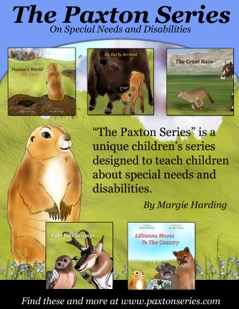
We call the series, “The Paxton Series” with our setting in the Black Hills of South Dakota, paxtonusing the wild animals of the area as our characters.  (Paxton the Prairie Dog shows up in every book, if nothing more than in a cameo appearance!)  The books are written for the child with the disability or special need….and for the child that asks, “What is wrong with my friend?” —and there are amazing illustrations, thankfully from someone who is able to acclimate the disability to the particular animal!
When the series started, I had no intention of a “disability series,” yet it morphed into this before I’d realized the need for this kind of material or impact it could make.  I attended a church organized disability conference two years ago and for the first time heard the term “disability people group” and learned much about these special people for whom I was writing!  The statistics astounded me!  I knew this was to be my life’s mission.

I am delighted to say this series is being well received –and will continue indefinitely! (The list is up to 60+).  Doors have opened I never imagined as schools, colleges (using them to teach students to be special needs educators) and other groups have found the merit of sharing these books with children, parents, educators, medical staff and others!

Invitations to share about the books from a “special needs” perspective, have also arisen and I am delighted to be an advocate for these children (and adults) who are often neglected in a variety of areas, (even if unintentionally) including written stories they can relate to.

There is very little actual reading material for children who have special needs; and paxton2certainly not for those young ones introduced to special needs children, as integration into mainstream classrooms continue.  Their peers are often confused by what they see as “different” and perhaps even “wrong” when it can’t be defined by the “normal classroom rules.”  My books attempt to bridge that gap, and are a great starting place for teachers.  They are written to aid in understanding, inclusion, and acceptance of those behaviors that are different from the traditional “norm.”

There are ten books in the series currently.

Paxton’s World on Fire                                                          Introduction

An Early Arrival                                                                     Preemie

The Great Race                                                                       Asthma

Ears Like Gramps                                                                   Hearing

Lillianna Moves to the Country                                              Down’s Syndrome

Micah Mink Goes to the Concert                                           Autism

Mixed Up Words                                                                    Dyslexia

Special Goalie                                                                        MD

Opal’s New Dream                                                                 Arthritis

The Camping Trip                                                                 ADHD


Coming soon:

The Spelling Bee                                                                    Diabetes   (September)

Madison’s Sad Christmas                                                       Depression (November)

Bristol Goes To School                                                          Cancer      (2019)

Harbinger Village                                                                   Cerebral Palsy     (2019)

Fabian’s Smile                                                                        Cleft Palate            (2019)

Our children face an amazing list of challenges.  God has placed me in a position to be able to do something fundamentally good.  I am humbled to be able to place words on paper that can help children understand what is going on in their bodies, as well as, a resource parents and teachers can use to help other children understand what is happening with their friends who seem different than themselves. If you are interested in any of these books or those to be released in the coming months and years, contact me, authormargieharding@gmail.com or visit http://www.paxtonseries.com or amazon.com.

**An added note — All 10 books are both in softcover and hardback….and we are just beginning to add a toddler version of the current K-3rd grade books (although the books are used for older students in special education classes, as well), and I am working on a chapter book!  The first toddler book, The Big Fire, should be available in just a couple weeks.


~~~~~~~~~~~~~~~~~~~~~~~~~~~~~~~

Margie – thank you for guesting. I’m grateful I could host your blog and further the word about these important books.  NL


Writer Wednesday: Writer and Writing is a Relationship

heartI know people say writing is a commitment, but it’s more than that. Writing isn’t “like” a relationship, it IS a relationship. A writer must be involved with the whole process of writing, must love it, need it, want to continue to work to make it better. It takes commitment, time, dedication, and the desire to move forward in life with writing.

A few years ago, I was at a conference where the main speaker (don’t remember his relat 1name) said, “You have to be selfish. You must take the time for yourself, for your writing.” He went on to say he spent every Friday at a hotel with his writing. (are you picturing him checking into a seedy, no-tell motel with an old typewriter?;-)

My friend joked, “Noreen does this thing where she actually spends time writing.” My regular action became fodder for humor because he is a writer, but he falls under the category of non-writing writers like many others.

Life happens. We have families, pets, jobs, homes, tons of responsibilities. But notice that list – I put family first. People we love comes first. This is why a writer might consider writing as a relationship – so they give it priority.

I schedule things around my writing whenever possible. I will make doctor appointments, meetings, and everything I have power to plan secondary to my writing by scheduling them before or after my planned writing time.

Once a person considers themselves in a relationship with their writing, they may relat 3naturally form relationship goals! If writing were a romantic relationship, how would you handle it differently? Would you want to go to sleep with it or wake up with it or both? What would you want to give it? Would you spend more time with it, going over the details, working it out so it was just perfect, going over it and over it again to work it out nice and smooth? What do you do for your significant other? Take it out to dinner? On vacation?

Writing, like a lover, needs constant attention and nourishment. Placing it on the back burner means we may never get to it. It’ll be there, but not as warm and flush as we’d like. Being in a relationship with writing means the needs of both are fulfilled. Writing is fresh and flowing and continually improved and the writer is happier, more productive.

We do this because we love it, we are driven to do it. Treat writing like it’s important to you.

Think of writing before you fall asleep, when you wake up in the middle of the night just to say one more thing.

relat 2

Coffee and your Character – Writer Wednesday

I’ve been thinking of coffee shops. And it’s not only because I’m a caffeine addict. Coffee and coffee shops are a part of our everyday lives and, therefore, our characters’ lives. What type of coffee shop and what they order will inform our readers of who they are in ways we won’t need to spell it out.

catwithstarbucks

I, personally, savor that first sip of morning tea. For a few moments, it’s the perfect temperature and I hold it close to my face, ready for the next sip as the first drips of bitter black tea warm my throat and my body, the caffeine going to work immediately to bring me to full wakefulness in anticipation of a busy day.

A friend described a man in her carpool who stopped every day at Starbucks for a large quadruple espresso latte on their way to work and on their drive back from work. But, she added, he also complained constantly about his budget. This told me a lot about the person in just a few sentences.

Does your character rush into Starbucks and curse the line? Probably orders ahead for pick up, but what if it’s not there? Or is your character the kind that seeks out the independent coffee shop because it may be less busy or just because it’s independent.

There used to be a coffee shop on Ventura Blvd between Hazeltine and Woodman. I don’t pinkremember the name, but I do remember the walls were pink. I liked it for it’s small town charm. Local home made jams lined the shelves behind me while local artists’ paintings adorned their walls. They only had a few wooden tables, a few more outside, and a few bar-type seats at the counter. Instead of the iced black or green tea choices at you-know-where, I opted for their daily choices, which might icled iced peach or raspberry-ginger. They offered an array of vegan or gluten free cookies as well. Who could resist?

I used this coffee shop in my story “Harvey Levin Can’t Die” (originally published in Pilcrow and Dagger Sept 2016). The story really is about change. How society reflects the harveylevincan't dieindividual and how the individual internalizes society. One of the characters worked there, but felt out of place. This also represented her life, she felt out of place and hadn’t really begun to make real decisions about who she was or what she wanted. But, of course, that changed and so did her involvement in the coffee shop and the guests as she becomes more proactive in her life. The reader is left to decide the interaction between her and society and whether the influence is good or bad.

It would have implied something different about my character if she’d worked at a chain coffee shop. The chain itself would have had an influence and been a foil. She wouldn’t have been able to grow and and the readers couldn’t see the change within the coffee shop itself; therefore, the setting was important in that instance.

Each place, each chain, is different. The people who go to the local Coffee Bean and Tea Leaf Company are different than those who go to Pete’s or even Starbucks. As writers, I imagine we’ve all spent time in these places. And our jobs as writers are to observe. Beyond the color scheme and coffee served, there’s a different atmosphere garnered by and at these places, and the people are different or act different.

I rarely see the impatient phone-bearing customers from the Monday morning Starbucks run at Pete’s. Nor do I see the more relaxed culture of the Pete’s “give me the multi-grain scone and flipped macchiato” at Coffee Bean.

1dollarstorysmashwordsI used another independent coffee shop for “$1.00 Stories” (originally published in The Chicago Tribune’s Printers Row Journal April – 2016). A mixture of independent coffee shops, one of which still squeaks by in the recesses of North Hollywood. I wanted a friendly owner and regulars my character would recognize. Not that he cared about them; it was more important for the story that they were familiar with Cris, and they accepted with good-natured-humor his occasional weirdness. I didn’t want to make him completely unlikable. I wanted him to come across as a little more complex, so he went to this coffee shop where he knew the owner and sneered at the community table while the regulars chuckled.

The joy I get from using independent coffee shops (or even invented coffee shops) is that I get to describe them, which will also tell us something about the character. In “Harvey Levin”, the character hated the pink walls. But using a chain also tells us something about the character.

Our characters are going to need caffeine at some point in the story. Giving the reader their choice of coffee shops, even in one line, gives the reader an insight into the person we’re creating.

Now my tea’s cold. But I don’t own a microwave and that never tastes good anyway.


Harvey Levin Can’t Die is available on Kindle and at Smashwords.

$1.00 Stories is available at Kindle and at Smashwords.


What’s New With You?

I’ve been remiss in my posting – which is a social media no-no.  icecreamCan I tell you a secret? I’m really just an introverted writer and I really want to do is:


Write!


Edgar_Allan_Poe_3


I had a fantastic time at the Poe Museum reading Eddy. They live streamed it (I didn’t know they were doing that!) and I’ve been invited back, hope to go soon!


27982653_1680480425366915_8840169907577678606_o

In the meantime, I’ll be at AWP.


But the real news today: my short stories – loving the covers! – are available for .99 cents on smashwords and kindle.


So – whenever you need something to do – click the link, read a story, let me know what you think!

Be Joyful!

Not Writing is Not an Option: Rethinking Writer’s Block

I’ve been under the impression that writer’s block was actually procrastination; however, someone wrote recently “whoever doesn’t believe in writer’s block has never experienced the sheer frustration it can cause.”

This, and the comments that followed, made me reconsider my position on writer’s block.

Experts state that very few people actually experience the psychological issues that cause real writer’s block. That statement, and my observations of procrastination in action, have lead me to believe that most people who say they suffer from writer’s block aren’t actually suffering from deep mental disturbances but of more common problems that plague us all – distractions.

However, the advice this person received caused me to pause:

“Drink heavily.”

“Don’t force yourself to write, it’ll come.”

These seemed the least helpful. While I know there’s a stereotype that follows artists and writers – the best ones suffer, and suffer from addiction in many forms. I doubt very seriously whether getting drunk will help the person. And, if you don’t write at all, how will anything come?

Other advice went something like this:

“Just write.”

To which one person wrote a long response about the ridiculousness of this answer. I, however, disagree. When asked by my students “what if you get stuck on a part?” I answered, I go on to a different part, or I write something else. I usually have more than one project going at the same time. I know some writers don’t do this, and I understand their reasoning. At this point, it works for me.

“Go for a walk, do yoga, meditate.”

This is actually pretty good advice. Studies show going for a walk or exercise in any form can feed creativity. Yoga is meant to calm the energy in the body so one can focus and/or meditate.

Others said, “listen to music” or “write a character study.”

This could help. While writing one novel, I listened to blues and jazz to help me give the character depth and personality.

Finally, someone asked the person who’d posted they had writer’s block and needed a solution: “What’s bothering you?”

Now, that’s a damn good question. Most of my writer’s procrastination comes when some thing is bothering me.

The person’s answer was different than I expected.

“I can’t make the story go where I want it to go.”

OOOOHHHHH!

This is a whole different type of problem. I learned writing in two ways. One method was to write a formulaic story with beginning, middle, and the end in mind. Use an outline and stick to it. And I can do this. But it’s no fun for me. The second way I learned was to just write and see where the story wants to go or needs to go. Most of my writing comes this way. It’s natural, it’s organic, it’s unforced; maybe that’s why it flows.

Think of how much power water has. Human-made streams run over their banks, create their own pathways; in one way or another, they defy the path man made. Think of how much concrete and lead it takes to build a retaining wall to create a dam, and still they must have holes or release valves. How many still end up crumbling, breaking, or overflowing?

That’s what writing should be.

Ideas and words should flow. Let them live. Trust them. Trust yourself.

If they are dammed up, forced into an unreasonable plot or direction, then I can understand that type of writer’s block.

The advice offered for that was: “write the end, and work backward,” and “move on to another scene.”

This should probably work if the plot of the story is strong and the elements are all in place. However, the person maybe be stuck because a needed plot point is absent.

Before any solutions can be offered, the type of “block” the writer is facing must be addressed.  Is it really, “I’m stuck,” or is it “I’m distracted”? If there’s a phone in front of you, and facebook, twitter, or your blog open while you’re writing – that’s probably writer’s distraction. If the writer is stuck at a plot point, at a character arc, I’d suggest to meditate on it, sleep with it, think about it until it works itself out, but I also suggest skip ahead, write another scene, write that scene/character you tell yourself you’ll never use.

See – it’s still writing. NOT WRITING IS NOT AN OPTION. No one ever got better at something by NOT doing it. No one ever finished a project by not doing it. No one ever became successful by stopping what they were doing.


A True Halloween Creeper Story

There was a challenge today in one of the writing groups to write 1000 word flash fiction Halloween story. This is a true story. It happened a few years ago. (It was written in an hour – so it’s not perfect)

halloween22


A True Halloween Creeper Story


Syd and I spent Halloween jogging in the rain. Our neighborhood doesn’t receive many trick-or-treaters, so this gives us a chance to see kids in costumes making their rounds. Sometimes the costumes scare Sydney; while dogs get the whole idea of doing crazy things for treats, they’re a little uncertain of masks and make up.

There are a lot of dogs in our neighborhood, which makes running difficult because of the social factor. The neighbors with friendly dogs stop and chat. So, toward the end, it’s more walk than run for us.

As I slow toward my own block, I run into Dan with his dog. Dan has a newfoundland; if the dog stood on his hindlegs, he’d be over six feet tall. A strong, powerful rescue dog, Dan said. “In case I ever need rescuing,” he joked.

“Where’s your wife?” The rain slowed to a sprinkle.

“Work trip. She’ll be gone til Saturday.”

“I didn’t realize her job required travel.” I’ve never seen one of them without the other. They walk their dog through our neighborhood on a regular basis.

Dan shrugs. “Yeah, once in a while.” His dog pulls him forward, and he yanks back. I smell the alcohol on his breath as he yells, “heel!”

Syd’s half the size of his dog, but the same color. She turns to look at him, even as his dog ignores him.

“What are you doing tonight?” Dan asks.

“Hiding from the kids. I didn’t buy candy.”  I laugh.

“Oh, yeah,” he says as if he forgot it was Halloween. “You can hide at my house if you want. I have beers.”

I laugh again. “No. I wouldn’t want your wife, or anyone else for that matter, to get the wrong impression.”

He shrugs and almost loses his balance. It becomes apparent, he’s had more drinks than I first assumed.

“It doesn’t matter. She’s used to it. I do photography in my spare time.”

I don’t know Dan or his wife that well. I only know them from our run-ins when walking the dogs, a few moments spent here or there chatting.

“You’re a photographer, right?”

I shake my head, “No, just pictures of flowers once in a while.”

“Yeah, I can see that. I see you covered in flowers.” His eyes shine as the last sprinkles of rain hit the ground and he pauses to look at me.

“Uhm, excuse me?”

“I photograph women, models. I’d like to photograph you.” He gets that half smirk that I’ve seen on men in bars when I was younger. A last ditch sales pitch that’s sure to hit. They, like he, doesn’t realize how incredibly silly they look. Dan’s older, he’s heavier. He has the appearance of someone who indulges in too much of everything except self-care. His skin is ruddy, hair unbrushed.

“No.” I say. There’s another block before my house and he’s heading the same direction. I hope another neighbor comes out to say hello.

“It would be strictly professional,” he slurs. “I’ve photographed hundreds of women, thousands. I used to run a website.”

“A website?”  He told me before he worked for the city; he’d retired early. I hadn’t believed that at the time, but didn’t care. Much like I don’t care about this conversation and I’d rather get to my warm, dry house and give Syd a treat.

He leans in, the scent of alcohol billows in front of us. “I don’t tell many people; it’s not something to be talked about in pleasant company.” He half laugh, half grunts.

I fall back a step, lean over to adjust my shoe laces. Maybe he’ll keep walking. When he stops and waits, I ask, “Does your wife know about the website and the photography?”

He shrugs again. The dog yanks at him and he yells louder than before. “Freaking, g’damnit, heel!” The giant, near panda bear, turns his head, seems to snub him, and pushes forward with less force.

Sydney slows down, lowers her ears, then she stays by my side as we start walking again.

“You know, I told my wife, it doesn’t really matter if we’re married or not. I mean, she could take one house, I could take the other. You know? Who stays married anymore, right?”

I see another neighbor, Jenny, coming toward us; I wave madly. She’s jogging with her little terrier, Fritzie. I hope she’ll stop, talk; I think, if she does, I’ll walk in the opposite direction with her.

“Hi, Jen!” I say loudly. She’s wearing her earbuds under her hoodie and I’m not sure she can hear me.

She waves, picks up Fritz and quickens her pace around us. I imagine she’s afraid of Dan’s dog. But when I see her sideways glance, I wonder if it’s more Dan that freaks out her. Suddenly, more things make sense.

“I could do the pictures very tastefully.” He half chuckles. “It’ll only be me; what are you afraid of?”

I decide to take the clear, hard line with him. “Well, I have children, and I’m a teacher. I’d be afraid to compromise my ethics and lose my job.”

We’re just a house from mine. I cut across my neighbor’s and my own lawn. The misty night has left my skin damp, but it’s him who makes my skin crawl.

“Well, if you know any young girls….” he calls behind me.

“I’ll be sure to warn them away from you!” I call back. Once in the house, I see him pause at the end of the drive, probably trying to make sense of what I said. I lock the door, turn out the lights, and give Syd treats; then we sit in the dark to watch someone a little less creepy, like Michael Meyers.

michael-myersjpg-c73192_1280w


What Do Published Authors Know?

Recently, I read a mini article posted on a blog of sorts, wherein the writer called out Stephen King’s book On Writing, concluding that “famous writers don’t know Jack.”

king1

WOW! Really?


I was shocked and offended. And I assume that is the reaction she wanted to elicit in order to bring traffic to her article or her own website.

Let me clarify that I am not an avid Stephen King reader. I’m not much into science fiction, but I have been reintroduced to his work upon reading Doctor Sleep, the continuation, in some sense, of The Shining. I have read On Writing some years ago. I’m pretty certain it’s still on my bookshelf as it’s required reading for anyone who wants to write – whether you like it or not. And my favorite essay of his, which I sometimes share with students is “Why We Crave Horror Movies.”

Therefore, I’m not defending a writer I love with a passion but an author I admire with sincerity. And I am taking issue with the blogger’s lack of professionalism in her disrespectful and disingenuous response to a successful and prolific author.

Stephen King

In Academia, occasionally members of the community in praising literary fiction take issue with popular literature. In one such class, when someone asked about King, the instructor responded – “In 100 years, no one will remember him.”

Yeah, I’m guessing someone who has written over 50 novels as well as over 200 short stories, among others projects will be remembered.

Again, my issues with her article is that she comes across as disingenuous. I don’t believe she really believes King is wrong, I think she wants to make a name for herself and create a controversial reaction and bring traffic to her website, so she can look at the numbers and get a little thrill when it pops up instead of actually presenting sound and original ideas. I say this because she didn’t actually say much of value.

This blogger’s premise is that writing is a gift and it is done intuitively, so authors don’t necessarily know how to explain writing. Understood. As well, she takes issues with some basic rules that I’ve learned since third grade. She says, “we’d all end up sounding like Stephen King.” Not necessarily so.

king2

Her final claim: “You can do anything, provided that you can pull it off.”


Well, duh! You can break every damn rule of writing if you’ve got a story so great that Hollywood will buy it and the publishers are going to make bank from it.  Dare I talk about The Hunger Games?  As an English teacher, it hurt my eyes to read the numerous punctuation errors. But, as one of my editors said, Story is King. It’s the story that matters, not the comma splices that most non academics won’t even notice.

However, every good writer should know the “rules.” And I’m using that term loosely here. A writer should be familiar with what has come before, what others are doing, as well and what others believe the rules should be.  How many people have commented on Picasso’s blue period, ignorant of his background, and said “I could do that!” Picasso learned and practiced the rules. Then he chose to break them. When I break a rule of writing, I ask myself: “Is it for effect, and is it resulting in the desired effect?

I say: “Break that damn rule if you want. Just know why you’re doing it and if it’s working.” If Stephen King breaks a rule, even his “own” rule, I imagine he knows it and knows why he’s doing it. I don’t think On Writing is prescriptive; I believe it’s meant to be descriptive.

So, I suppose I don’t even have that much issue with what she said, but it’s how she said it. Stephen King is an award winning, multi-best-selling author, show some respect. That’s called Professionalism. You can disagree with someone, you just want to do it respectfully.  She says she leaves the “writing instruction” to the “less qualified people -“.

king3.gifREALLY?  The author of over 200 short stories is less qualified than who – YOU?  How many books have you published?  I looked her up. A few “middle grade readers,” a nonfiction book, a few short stories. She says she prefers to tell people how to get published.

I go back to her line, “famous writers don’t know Jack.” How unprofessional can you be?

I teach a business writing class (among others); I run the class like a course in professionalism. And this is something I would say is an absolute NO! We can disagree with anyone – I tell my students – but we should know how to respectfully disagree.

As a writer, I see a lot of unprofessional behavior. (I in no way claim to be perfect myself).  I belong to writers’ groups and read (more than I post) in these online writers’ groups. And it can be things like this – open to the public – that can get a person in trouble. You never know who you are dealing with on the other end of that computer. Random arguments, stupid comments, and radical, unqualified statements can hinder one’s success.

I was asked recently by a publishing company for my CV. This is not a problem; I sent it right over. Why would I not?  I posted asking for advice about the CV, for future reference. Some people seemed beside themselves, as if a publishing company asking for my CV was out of line. The publishing company is my potential employer. They are entitled to my CV and, as a professional writer, I want to show it to them!

Now, what if I had written a blog such as that – disrespectfully and disingenuously criticizing one of their best authors? It might cause the publishing company to think twice about even looking at my work, let alone looking at my CV. The cold, hard fact in this world is most companies are not going to hire or work with people who are unprofessional. While they may want people to speak their minds, they don’t want people publicly running off at the mouth. Charlie Sheen and any number of actors learned this the hard way.

king4

I am not at all saying that we shouldn’t voice our opinions! If you disagree with anyone, you should be able to, and have the absolute right to speak your opinion. I’m suggesting it be done with polite professionalism.

Who is this author of a few middle-grade books to be criticizing King? She is never going to convince ME or many writers that King is wrong. However, had she respectfully disagreed with his views on the certain aspects of writing, clearly stated her reasoning – it would have been far more professional and more believable! I would have read it, taken her opinion into consideration, and possibly even agreed with her. However, by her announcing that he is “less qualified” and doesn’t “know Jack,” not only do I question her intelligence and her integrity, she’s possibly offended people she’d rather have as friends or colleagues. (You’ll notice I didn’t link her article here. I’d prefer not to give attention-seekers more attention).

I, personally, would rather respectfully disagree with people than announcing contrary opinions for the sake of readership. I guess being boisterous will get you noticed. But, it will also get you noticed, if you know what I mean.

I’ll take her words, “You can do anything, provided that you can pull it off.” – Yes, yes, you can. You’ve seen numerous examples of people running off at the mouth about others and nothing happened to them or their career. However, are you sure you can do it and not experience consequences? Have yking5ou built up enough credit, have enough backing, or whatever else you need, to make certain you will not face consequences. OR – have you done this, seen it done, heard it done, and the person hasn’t gone very far in their career. Hmmmm.  Might be a reason.

Say what you will. I suggest you say it with respect.