Women’s History – Women Writers

How are you like a peanut?
I gave this prompt to my students. Even as I was assigning this prompt, I saw the looks on their faces. They were not the first class to question my sanity; that happens regularly. So, my answer, must be “I’m a little nutty.”
Some of my students came up with amazing responses.

This is challenging and, as writers, we must challenge ourselves. When we challenge ourselves, new parts of us open and allow us to grow and see life from a different point of view.
Choose an item from your refrigerator or snack drawer and compare it to yourself.
(Or choose an item and compare it to your main character.)
If you’d like to share it in our group, please do. 

Maybe it’s me, but I doubt I’m alone in this: A writer’s support system sometimes seems a shaky and insecure. Some people do not understand, others say ridiculous things, and some are even jealous of our steps forward.
Finding a support system is an active and ongoing endeavor. People move on, they step back, and we need to keep moving forward, be unwilling to let negative people and comments to hold us back.
Don’t be afraid to move on. It doesn’t mean you have to cut contact with everyone or even anyone, but you certainly want to keep those who are positive supporters of your in the forefront of your mind and heart.
Sometimes, we feel very alone. Writing is a solitary act, but we don’t have to live in a bubble. Make contact through writer’s groups, online and in person. Meet other writers at conferences or critique groups and stay in contact with them. Join a book group, we need friends.

 Writer’s block is the writer’s arch enemy.
And though it can be solved, one of the problems is that it takes faith to believe it can be overcome and it does take work.
Someone, recently, asked me how to get over a block and I gave him the following advice. He responded, “that’s too hard!”
Too hard???
If you want to get through a block – you have to push. If you are not willing to do the work, then why are you here?
One way – and it is just one idea – to get through writer’s block is to write your way out of it.
Use a separate document, handwrite it, get out of the story you’re working on and write somewhere else – but write, and keep writing – it might take you ten pages to get to where you need to be, and you might get two or three good pages out of that – but guess what, you will have written yourself out of the block.
Ten pages not enough? Still feeling blocked? Keep writing!
Think of it this way – something is in your way. If you were driving somewhere and the road was blocked, would you turn around and go home, go back to bed, and give up? Or would you use mapquest to find a different way to get there.
Something is in your writing way, get off that street (document), look at mapquest (other ideas, roads, methods, ways), and get moving.
 Sometimes, that’s what writing feels like.
I recently finished a particularly difficult story. I’d written it over the summer. Then life happened, and while I wrote here and there and started new things, finished other things, submitted, and even came back to this story repeatedly, it refused to be finished.
This story became the terrible twos who kept throwing a spoon down on the floor and crying for me to pick it up only to throw it down again.
When my real children did this – I left the spoon on the floor and shrugged, “guess you’re using your fingers now,” but you can’t do that with a story, huh?
But what you can do with the story – as with all writing – is keep showing up. That’s what I did. I kept putting that story in front of me and trying to work out of the kinks. We can’t give up the story when it gets hard.
One of my favorite stories is one Stephen King tells about Carrie. I’m paraphrasing here: His wife found Carrie in the trash and brought it back to him, saying something to the effect, you can’t stop just because it got hard.
(of course these are the days when we used typewriters or notebooks and were able to physically put those in the trash and not just click delete, which, by the way, don’t ever do! Ignore the story, put it elsewhere, but don’t delete it!)
And I’ve read/heard the above King/Carrie story a few different ways, so it may not be exact; however, the point is – You can’t give up a story because it’s hard.
Even if the story never gets published – I learned something by writing it, by sticking it out.
The new term in student success is “Grit.” (I know, it’s also an old John Wayne movie). It alludes to the idea that the students who struggle and push through who will become a successful student and graduate. It applies across the board – school, life, and definitely writing! (Not surprisingly, to that movie as well).
I recall another story I’d had a particularly challenging time with. And just when I thought it was finished – the dreaded blue screen! It was gone. Memory wiped. I gave it a few weeks (and a long weekend in New Orleans) and came back at it. “Psychic Surprise Party” was published six months later in The Oleander Review. (It will be republished in May online).
Even if this one is never published, I learned something by doing it. I’ve learned something in all of these not-yet-published stories and poems. We are writers. We are driven to write. It is our little corner of the puzzle-solving-world in which we exist.
The next one might be easier. And maybe it’s  this challenging one that will push something out of the way for the next one. Maybe the next one will be difficult too, but we’re going somewhere, learning something – keep pushing through.
That’s what makes us writers.
And we’re all a little mad here…..
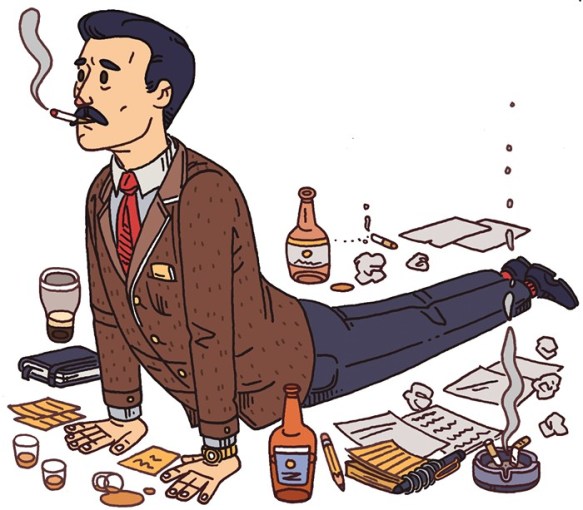 Writing hurts – no, seriously, sitting for long periods of time makes my back ache.
Now, we have standing desks, but studies show that’s only moving the pain around, not really as good for you as first thought.
My trainer recommends getting up every fifteen minutes to stretch and walk around. But, when I’m in the flow, three or four hours have gone by and I’ve even forgotten to eat!
Longfellow may have been the first 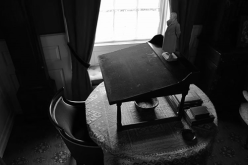 to use a standing desk; he alternated between sitting and standing, which I think is a good idea.
Charles Dickens described his writing as “prowling rooms, sitting down, getting up….”; It’s purported he owned “all manner of comfortable easy chairs.”
It’s more about the way we sit and stand that is hurting us. Our shoulders coming forward and our heads hung puts far too much pressure on the back of our necks and can cause permanent damage.
Laptops don’t help. When we had our desktop computers, it was all about raising the screen to eye level, sitting in an ergonomic chair, with our arms at a comfortable angle. With laptops, either our head is tilted down or our forearms at a strange angle.
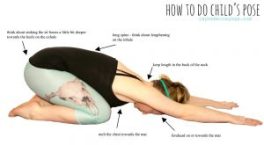 Yoga to the rescue! In order to keep our backs and legs healthy, there’s a few simple yoga poses (you could even do some of them at your desk!).
Spinx pose will help with those rounded shoulders and neck pressure.
Child’s pose and/or downward dog will also relieve some of the  pressure.
Thread the Needle Pose is one of the best.
These are the easiest, but writers can benefit from a regular yoga class or a yoga routine.
 Many posts in writers’ groups and questions in writerly gathering surrounds the fear of family or friends finding out what they are writing.
Surprisingly, some of these are fiction writers. Although many are memoirists, poets, fiction writers and essayists are also concerned with offending someone they know.
My response to this is: They’ll probably never recognize themselves! The truth is many people see themselves far differently than others do.
Furthermore, studies show that we remember events differently; to be more accurate, we remember different details of the same events, and our memories are not as reliable as we’d like to think.
Legally, in memoir, if names are changed, there is little a person can do if they do recognize themselves. One attorney told me: They’re welcome to write their own version of the events.
Fear  should never hold a writer back. A small change in details or location can allow for some question if someone does think the story might include them.
Even if you think you’ll never publish it – write it. You’ll feel better!

Poe’s secret for inspiration is used by many writers today.
Poe scanned headlines, read newspaper stories, and gleaned ideas from the oddities. His  story Berenice is about a man who digs up his dead wife and takes her teeth. This is reportedly inspired by newstories of grave robbers, some of which left the body and took the teeth. Another story reportedly inspired by a news report was the Facts in the Case of Valdemar. At the time, there were reports of people who could speak to the dead; there were other stories of ways to prolong life. Poe, it seems, blended these and created a story in which Valdemar “survives” and “speaks” beyond his natural life. This short fiction was thought to be real. People believed it!
Inspiration, for me, has come from the odd news story. A human interest story in which a homeless man was selling stories on a New York street, inspired me to write $1.00 Stories.
Another story flickered to life when someone posted a handful of gold teeth and said she’d inherited them. How does someone come into the possession of teeth, not their own, and why would they will them to a family member? Hence, The Gold Tooth springs to life from my suspicious mind!
Scan the newspaper, and let your mind wander. We’re writers; we have the desire to understand, explain, and create.
Happy Writing! 


 Noreen Lace
You must be logged in to post a comment.