Special Needs Authors and Readers – an Interview with Patty Fletcher

Hello:

Thank you so much for having me on your blog. I’m very glad to be here.

As I’ve been reading over the questions you ask, I’ve decided the best way to begin answering them is to start by telling a bit about myself, and why I write.

As you read, you’ll also see that I’ve included Campbell my Seeing Eye Guide Dog and why I chose to do so.

SmashwordsCoverMy name is Patty L. Fletcher. I’m a single mother with a beautiful daughter, of whom I am very proud. I have a great son-in-law and five beautiful grandchildren. Three girls, and two boys. I own and handle a Black Labrador from The Seeing Eye™ named Campbell Lee—a.k.a. Bubba Lee or King Campbell, to give just a couple of his nicknames.

I’m multiply disabled. I not only suffer from Bipolar Disorder, and Fibromyalgia but I’m totally blind as well. I was born premature and my blindness was caused by my being given too much oxygen in the incubator. I was partially sighted until 1991, at which time I lost my sight due to an infection after cataract surgery and high eye pressure. I used a cane for 31 years before making the change to a Guide Dog, which was the inspiration for my first book, ‘Campbell’s Rambles: How a Seeing Eye Dog Retrieved My Life’ CN-2014.

When I began my writing career with the publishing of that first book, my purpose was to tell the story of how going to The Seeing Eye™ and getting Campbell, learning to love, handle, and work him, then coming home and adding him to my life, gave me true freedom. I told of how changing from being a 31-year cane user to being a guide dog handler taught me things about myself I had never known before. I told of the wonderment I experienced when I finally took that chance.

Continuing onward,  as in the beginning, a major goal of mine is to help others who find themselves in domestic violence situations. I also want to help others learn more about mental illnesses and how different situations and environments can drastically affect those with such challenges.

As I write I focus on bipolar disorder, on how it can go horribly wrong and cause a person to behave in ways they normally would not.

Another thing I have attempted to show in these many years of writing is how, in certain institutional settings, attachments can develop—and how those attachments can become unhealthy for all concerned if they are not handled correctly. Most simply, I want others to know more about me.

I’ve written a second book as well. Campbell and I wrote it together.

‘What do you mean? What was the purpose of this book?’ You ask. Let me explain.

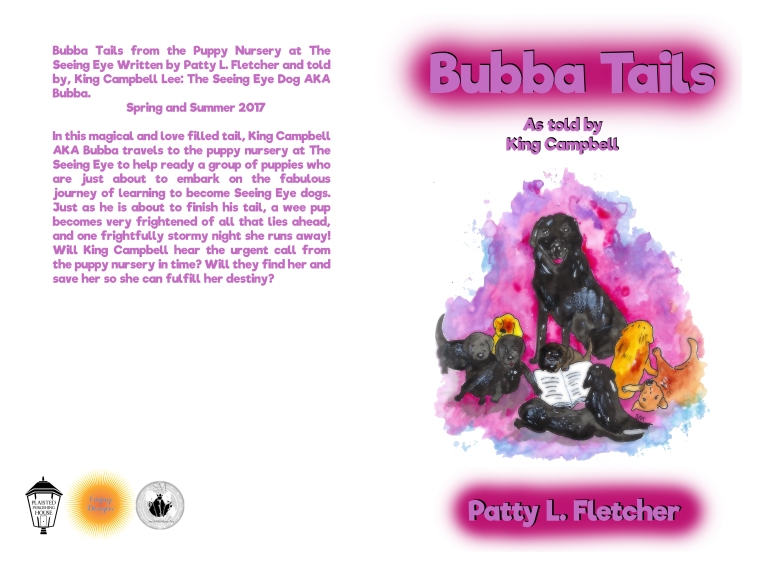
The book is, ‘Bubba Tails From the Puppy Nursery At The Seeing Eye’

In Bubba Tails From the Puppy Nursery At The Seeing Eye, it is King Campbell Super Seeing Eye Dog A.K.A Bubba’s turn to tell his tale.

While helping to ready a group of pups to go and meet their puppy raiser families, so they too, might one-day become Seeing Eye dogs, he tells of what it was like for him, to grow up and become a Seeing Eye dog.

As he speaks to the wee pups, he speaks about the importance of facing one’s fears, of honesty and how telling the truth no matter how hard, is always best. He speaks of love, faith and of believing in one’s self

Because Campbell and I are together I feel it is important for you to know him as well.

WHO IS CAMPBELL AND FROM WHERE DOES HE COME…?

Campbell was born in Chester N.J. November 28, 2008.

He lived with his Dog Mother and Litter Mates until he was approximately eight weeks old, and then he went to live with his Puppy Raisers.

Then, when he was just over a year-old, he was taken away from his Puppy Raiser family, to be trained at The Seeing Eye.

After only four short months he was chosen to become the guide of his now human mother Patty L. Fletcher.

One more important thing we must add, because of The Seeing Eye being the first ever school of this kind and due to its continuing to be the largest and oldest school in the world, before we continue, we’re obligated to post the following information. We’d love it if you’d visit the site sometime to learn all about how this wonderful Guide Dog movement began and what it takes to continue today.

Legal Notes THE SEEING EYE® and SEEING EYE® are registered trademarks of The
Seeing Eye, Inc.See: www.SeeingEye.org


What do you think the publishing world needs to do more of in order to meet the needs of those who are differently-abled/disabled?

I must say I am quite pleased to have an opportunity to answer this question. Being a multiply disabled writer most certainly can be extremely challenging. So much so that I wrote an article about it. Which, I might add was well received by many in the self-publishing world. If readers would like to have a look they may visit:  https://­campbellsworld.wordpr­ess.com/2018/02/07/­challenges-of-a-disab­led-writer/.

In the article which was also published in the Indie Publishing Magazine, I talk about the various challenges disabled writers face. Things such as:

  • Photos, Screenshots, and Memes which have no descriptive text.
  • The challenges of correctly dealing with words which sound the same and are spelled different, and:
  • Books that aren’t TTS (Text To Speech) enabled, websites that aren’t accessible to those using screen reader or voice over technology, and lots of other things the general writing world just doesn’t consider when dealing with writers who have special needs.

I must say the next question you ask is my favorite and comes to me at a time in my life when I find daring to be different whether by design or choice is hard as the devil to do.

You ask:

What do you think the world in general needs to do in order to understand the needs of those who are differently-abled/disabled?

The best way I can answer this is this…

Be open minded. Don’t put people into boxes. I’m a multiply disabled person. I think, act, and work differently than anyone else.

But.

That’s not all due to my disability and I see a lot of this going on.

The world needs to be more accepting of things that aren’t the “Traditional way of doing things.”

One of the biggest reasons I gravitated to Indie Publishing and especially blogging was so that I could go my own way, do my own thing and be OK doing so but of late I don’t seem to fit in.

Honestly, it’s starting to seriously drag me down. Seems like no matter where I go or what I do someone somewhere disapproves.

Well, to be blunt I’m quite tired of it. No two people are the same. We’re all “differently abled” All of us no matter who we are have things that are hard for us. If people stopped and seriously took a good, long, look at themselves they’d realize that no one is without some kind of disability and I just get tired of there being all these pigeonholes that I’m supposed to fit into.

I just want to be allowed to be myself, write in a way that makes me happy, tell my stories in a way that feels comfortable to me and not have all these other people telling me what I should and should not do.

I am not them and they’re not me. They don’t live my life and I don’t live theirs.

I am a 51-year-old totally blind woman who suffers from other types of disorders as well and these disorders cause me to think, feel, and process life around me in a way that is unique to only me.

But.

Is that not true of everyone? Do we not all deal with life as it comes to us in a different way? If you read something and I read that same thing are we both going to receive the very same message?

If you choose one way to put your work out there for the world to enjoy and I choose another is your way any better than mine?

I guess I’m just tired of the “world” thinking it knows what’s best for me.

I’ve a favorite affirmation it goes like this…

“The world is not perfect, so there-for I need not be perfect.”

If I were to sum it all up into one word it would be, ‘allow’

‘Allow’ me to be who I am. ‘Allow’ yourself to be who you are.

In closing let me share these words a dear friend once wrote to me during a time in my life when I was doubting my ability to succeed. He wrote…

“Patty,

Congratulations on your success! Yes, success.  All successful people (writers are people too!) get criticized – a lot.  There is an entire industry based on criticizing books, movies, plays, sports, cars, etc.… the list goes on forever.

Don’t let the criticism get to you.  You put in the work, you made it happen – only you get to decide if it turned out the way you intended.  No one else is qualified.  Forge ahead, do what is in your heart, write your books, sing your songs, dance your dance – be you.  Everyone else can worry about being themselves!”

Thank you very much for this opportunity to speak about myself and what it is to be a disabled writer in a world in which it can at times be hard to work and belong in.
Bubba Tails Wrap 6x9


~~~~~~~~~~~~~~~~~~~~~~~~~~~~~~~~~~~

Thank you, Patty!

noreen


Approaching Authenticity – Creativity, Psychology, and Christian Faith by Bozena Zawisz

bozenaSomething I often hear as a counselor is clients speaking about the weight of expectations they feel they’re carrying on their shoulders; and the frustration, guilt, or resentment they feel in relation to them.

Many of these expectations are often tied to a particular role they “fall into,” that contains within it: unexamined assumptions relating to some action(s) they feel they should be doing, rules for communicating (what they feel they should be saying, and how), pressures to take on board “shared” viewpoints…

Often they express feeling as if they lost their center or connection with themselves.

Some roles are consciously/purposefully chosen. I choose to relate to clients within the boundaries of a counselors’ role. At other times, individuals can fall into an interaction where there is an expectation/pressure to engage in a “role-play”… mindlessly… pulled by some emotional pathway, deeply engraved by a lifetime’s worth of conditioning… For example, many adults continue to feel strongly affected by their parents’ perceived expectations of them…

Sometimes individuals’ roles within relationships include assumptions about hierarchy (in some cultures more than others), expectations relating to distributions of privileges, expectations relating to the division of weight that is placed on the inner experience of each individual. Often, the language which does not fit an expected role-script is unwelcome, discouraged…

One of my favorite historical examples of a figure who modeled the importance of rising beyond roles and cultural expectations, and embodied authenticity and inner strength, was Jesus. I admire the way he kept right away from describing himself via popular roles or politically loaded terms of the time, which he perceived as a poor fit with his life’s journey and purpose.

I love the way Jesus preferred to describe his inner experience and communion with God using creative metaphors-that beautifully made use of people’s familiar associations (e.g. used imagery such as harvests, laborers, etc.) yet transcended the language of the well established familiar social and political roles, traditions, expectations, and their underlying beliefs and perceptions.

Jesus had a hard time with the Pharisees. Perhaps they perceived his non-compliance with the established roles that reinforced their power and privileges-most unsettling. Jesus smacked too much of personal power, disregard for the authority of political/social pecking order…

Possibly to connect with a sense of inner peace, he was documented to withdraw into solitude oftentimes, perhaps in this way he restored his strength by nurturing his connection with God. Just as in his case, I believe that it is a helpful first step in our journey towards authenticity to find ways to connect with a loving place of self-care and strength within ourselves.

Given the powerful focus our society (and at times other people) have on trying to hijack strong within_frontour attention and encourage us to look to the outside of ourselves for fulfillment–creative expression of, and reflection on, our inner experience allows us to re-center and reconnect with our inner journey of transformation.

And, support us in reclaiming control over reconstructing our experience so that it resonates with our values, faith, the direction of our journey, and more closely aligns with our truth.

Bozena Zawisz

Website

Neither Innocent or Guilty


~~~~~~~~~~~~~~~~~~~~~~~~~~~~~~~~~~~~~~~~~~~~~~~~~~~~~~~

Many Thanks for sharing!

noreen

Fear of …?

istock_000012625357xsmall1There’s a theory that we don’t fear failure, we fear success.
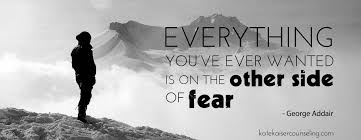
A researcher gave graduating students an impromptu essay prompt: “After finding out Joe/Jane aced their medical exams for graduation, he/she …..”

It’s reported that the vast majority of students set up a scenario in which Joe or Jane went out and partied, got in some sort of trouble, an accident, arrested, or in some cases just gave up and “decided to do something else with their lives.”

The researchers decided this was not an indication of the fear of failure, because they’d set up a scenario in which the person(Joe/Jane) had already succeeded, yet the students then wrecked the plan. Therefore, they surmised it a fear of success.fear

This possible fear of success comes from anxiety, which is rampant in society today. People stay where they are comfortable, where they are familiar, and their habits serve them. Moving on to the next level, success, will bring about different challenges, and the fear of the unknown wins out.

It occurs to me that this happens to writers. People write, and write, and write, but then don’t submit. Is it really the rejection they fear? or is it the success?  Think of all the anxiety that comes with the next level of publishing. You’ll be expected to do well, to do it again. And, what else might change?

What do you think? What do you fear?

images


Word Problems – a poem by Noreen Lace

communication-problems.png

Word Problems


I hate when men write

soft poetry about their ex’s.

It’s easier to read the hate

than to let your mind wonder

“what went wrong?”


It’s easier to hear, I don’t love

you anymore,

than to hear I love you, but…

and the thousand buts

that say you just didn’t add up.


I mean she…

back to the poet with the soft poetry

and the lost wife.

He writes it, not to her,

but for himself,

to remind himself

of what he let go,

the additions he didn’t add in

when he was subtracting

all she didn’t have.


All the things he didn’t have

all the while he’s telling himself

he was right

to let her go

when he did

because things would have gotten worse

had they not parted before the math was done.

At least this way he can ruminate,

look back fondly and say,


we parted as friends,

Meaning,

I departed quietly to search for something more,


she just got hurt.


*originally published in the Northridge Review 2002.

northridge review


This was written long ago, while I was finishing graduate school. I think it’s still so relatable. One person is always ready to go before the other. One person walks away, the other crawls.  (But don’t worry – the one who crawls gets up, becomes stronger, and thrives!)

Much love, readers.


Friday Feature: The Overlooked, The Forgotten, The Displaced: Unbridled Inspirations – By Dianna Brown


Close your eyes for a few seconds and think of the word ‘inspiration.’ inspirationWhat comes to mind? Are there images of magnificent places you’ve been, impressive people you’ve met, or extravagant stories that stimulates your soul, sparks your imagination and almost brings you to tears? These everyday inspirations lead me to be the best version of myself, however, this is not a source of inspiration for my writing.

What if I told you my writing inspiration is in the overlooked, the forgotten and the displaced? I see potential in the bleakness of a shadow. I take interest in peculiar sights. I notice the unnoticed. My desire to write stems from the stories that are cut short. Not just unrequited love stories, but stories attached to the abandoned—whether objects, people or places. I am intrigued by ghost towns, and the remnants of memories left behind.

Sometimes inspiration comes from one word. I have a fascination and love of words. Maybe it’s a name, a word I overhear in conversation, or one that stands out while I’m reading. To me, words hold weight and are springboards for the fine details of characters, setting and, sometimes, plot. I call these words, triggers. One word triggers a plethora of infinite possibilities. Couple this with an innate curiosity about the little things in life and inspiration calls out from every direction.

Inspiration also comes from pain. Writing is a resiliency of spirit. It provides an avenue to unleash hurt by navigating emotions through an alignment of fictitious stories. I also believe the act of writing is an acute desire to heal. This is true for reading as well, as there is nothing more enjoyable than being whisked away in the transfixation of a book.

I wonder sometimes if writing is a window into the subconscious. Much of what I write is not intentionally thought about, but comes out in a stream of consciousness that can surprise me. In dreams, I hear the music of the most haunting melodies and poetic lyrics. In the middle of the night you can find me scribbling what I remember by the light of my phone, blurry-eyed. Unfortunately, in the morning the indecipherable lines can never match the beauty of my dreams. Words that enter my mind are often ones I’ve never heard of before, and after I’ve written my word count goal, I will look up the definition of the word, to find it fits perfectly with the meaning of the sentence. Although it’s likely words stored in my subconscious, that I’ve encountered somewhere along the way, it shocks me nonetheless.

When I wrote the novel ‘Saltwater Joys’ I had inspirations from childhood memories of oral Newfoundland folktales and ghost stories—ones I still love to hear again and again. I explored these memories and extended the stories into what might have been, had the story taken a different turn. It is like a scavenger hunt in my mind. One idea gives me a clue to where I might go with the story or character next. Other inspirations for this literary fiction novel came from the works of Edgar Allan Poe, as well as many classic tales and poems that made me see the unimaginably intricate, and sometimes horrific, connections in life.

inspiration2I like to explore the darker sides of life, which is interesting to me because I am naturally a good humoured optimistic individual. There are an unbounding instances of inspirational dualities in life, the play between light and dark, life and death, vice and virtue, and I realize as a writer I am one of them.

Dianna Brown’s Website


~~~~~~~~~~~~~~~~~~~~~~~~~~~~~~~~~~~~~~~~~~~~~~~

Thanks, Dianna.

noreen

Friday Feature: Just a Bit O’ Dialect by Expert Story Teller David Francis Curran

Just A Bit O’ Dialect

Dialect can make anything from a Sci-fi novel to a western story come alive with unique and realistic voices. But if your English fiction contains text as obtuse as:

Da grill da bik rude

it is unlikely that your work will be published.

To master the mystery of writing good dialect it helps to have a little insight into the difference between the rules of English, and effective communication. Some years ago a communications researcher at the University of Colorado, Dr. Sally Planalp, did a study on transitions. She took articles featuring various types of transitional links between paragraphs, broke them up into individual paragraphs, and then scored each transition on how well students could put the paragraphs back in the proper order using transitions as the key.

Most of us are to used to the idea that there are rules in the English language and students get graded on how well they know them. What Planalp did was grade the rules on how well they helped people understand what was going on. When we write in dialect we are breaking the rules. What we need to know is how to break them in such a way that people will still know what is going on.

There are three basic rules that pretty much sum up how we understand what we do understand in our language.

Semantic rules govern the meaning assigned to words. For example in the obtuse example above I substituted “da” for “the.” Semantic rules are arbitrary. There is no reason, for example, why a cat couldn’t have been named a “Meow.”

Syntactic rules govern the way in which sentences are put together in a language. In English we would say “The girl rode the bike.” Other languages have different syntactic rules. A German, would say, for example, “The girl the bike rode.”

The final rule, is Regulative. These govern the meaning of a communication based on the context. For example, the difference in a mother saying, “Johnny!” when her son gets a good report card, and “Johnny!” when the boy has just emptied the entire laundry detergent box into the washer. There is much more to regulative rules. They are the reason that, even though we somethings mispronounce words, or use the wrong words when speaking, our friends still understand us. If you make the context clear your dialect will always be understandable.

Now that you know the rules you can write effective dialect. To write effective dialect, that is dialect your reader will be able to understand, break either the semantic or syntactic rules but never more than one of these rules at any given time.

To prove this, in my fiction writing classes I give students one long paragraph to translate in which I’ve broken only the semantic rules. I’ve included a shorter example below. (It will probably be more fun to try solving this by reading it out loud with a friend.) See if you can figure it out.

Hum pieity Dun pieity at onta wrull. Hum pieity Dun pieity wrad o grit brawl. Sol ta binks borsis wrend sol ta binks ben, wroudn’t but Hum pieity agrather awren.

Similar things have successfully appeared in popular fiction. In Larry Shue’scomic play The Foreigner the main character is presented as someone who does not speak English. When asked to tell a story, he tells Little Red Riding Hood, substituting made up words for the English equivalent. The audience always gets it, the characters on the set think it sounds familiar and the result is hilarious.

Did you solve the example above yet? As in Shue’s play I used regulative trick to help you. In both the story in Shue’s play and the nursery rhyme I used in my example above,the words sound a bit like the original English words. The sound helps, but when understanding comes it is more than just the sound of the words, it is that the syntax is English and words themselves sound familiar. The sound helps remind you of a context that you should remember from your childhood.

Let’s go back to the obtuse example at the beginning of this article. “Da grill da bik rude” hard to understand is that two rules have been broken, syntactic and semantic. You probably guessed by now that this is an attempt at a German accent, saying, “The girl the bike rode.” Two far simpler ways to hint at the German accent and still get the color of the speakers voice across would be:

(1) To use the german syntax with only words that can be found in an English dictionary, “The frÑulein the bike rode.”

(2) Or to use some German, or made up German words but with English syntax. “Da frÑulein rode da bike.” If you use another languages syntactic rules(1) your writing will be far harder for English readers to understand.

If you must break syntactic rules keep your writing to short sentences. The second version(2) gives a sense of a foreign language but is much easier for an English readers to follow, and is the most often recommended way to include dialect in a story.

We’ve talked about semantic and syntactic rules, but not regulative rules. Regulative rules are the most important of all. Regulative rules govern the meaning of what is written in the context of how you tell the story. Regulative rules are so important that, If you make the context clear enough you can go beyond dialect and even write in a foreign language. If you set up the context so well, that when a character speaks in a foreign tongue we know from the context ( that has been given in English ) the basic gist of what the character must say. Randy Wayne White in his Doc Ford mystery series does this exceptionally well in books like North of Havana. However, again, you want to keep the foreign language sections as short as possible.

One thing you should keep in mind when using dialect is that there is a paradox in the “translation” of foreign languages. Look at these examples of translations of Ihara Saikaku’s book The story of Seijuro in Himeji.

Here is a short section of the translation by Wm. Theodore De Bary:

1. Darkness is the time for Love; Love makes night of day In spring the treasure ships lay, with waves their pillows, on a quiet sea before the bustling harbor of Murotsu. . . .

Here is the exact same work translated by Ivan Morris:

1. Love Is Darkness, But in the Land of Love the Darkest Night Is Bright as Noon. The town of Murotsu is a great bustling harbour and here, in the peaceful springtime waves, rest the ships with their heavy cargos of treasure. . . .

I ask my students, how can two men, translating the exact same text come up with such different translations. The paradox is that in languages with far different grammatical rules, words and metaphors, the writer’s tools, may not be directly “translatable” into English and vice versa. Which means you should concentrate on capturing your story and not worry too much about the language. Dialect should be used only to give your writing flavor, like spice in cooking. If you put too much in and try to capture the foreign language itself you’ll ruin your soup.

To used dialect effectively break either syntactic or semantic rules, but break only one of these rules. Then use dialect sparingly, and your fiction will come alive.

David Francis Curran

~~~~~~~~~~~~~~~~~~~~~~~~~~~~~~~~~~~~~~~~~~~

Many Thanks, David!

noreen

Friday Feature: Valerie Cooper and Finding Writing Time

I’m more familiar with Valerie Cooper’s poetry, as we’ve both appeared in Delphinium Literary Magazine. So when she contacted me about writing a piece about finding time, I thought she’d have something important to say. We’re both single parents, except mine are now grown, which gives me more time. Hers is still quite young – and as I once did – she searches for little bits of time to write.

~~~~~~~~~~~~~~~~~~~~~~~~~~~~~~~~~~~~~~~~

vcooper1As a single parent, writing can be difficult. I’m required to be creative and write around my daughter’s schedule. I find time in the mornings, for twenty or thirty minutes, before I get her up for pre-school. At work, I take five minutes here and there when I can to make notes or outline an idea or twElise Climbing Rocks in Central Park NYCo. I get another hour, if I’m not too tired, after I read her stories and put her to sleep.


I know my friends who don’t have kids have more time than I. But, also, my friends who don’t have kids aren’t as focused as I am on being successful. Children take a lot of your time, much of your energy, but what you receive in return is far more satisfying than much else life has to offer. My daughter inspires me to work harder, to be successful. Before her, I thought, “I’ll get there some day.” But after she was born and I looked into those big, beautiful eyes, it lit a fire under me!

Many writers complain about not enough writing time. Life is busy and messy. We need to work around it. So sometimes I get up early. Other times, I stay up late. I get creative and grab what might be otherwise wasted moments.

vcooper3I write poetry in the park on warm Saturday afternoons while the children are screaming with joy on the climbing gym. I write lyrics in the parking lot, in the chilled air of my car, waiting for pre-school to end. I outline a story over the humid stove, while my daughter waits impatiently at the dining room table, chomping on carrots.
There is time, it just comes in increments, joyfully swinging around everything else in your life. It’s there. You just have to grasp it.

Valerie Cooper

Delphinium

The Kiss

~~~~~~~~~~~~~~~~~~~~~~~~~~~~~~~~~~~~~~~~~~~~~~

Thanks, Valerie. Much Luck!

For everyone else, I suggest one of these!

vcooper5

Friday Feature – Motivational Author Anda Stan: “To Be or Not to Be the One of Your Own Life…”

Man jump through the gap between hill.man jumping over cliff on              Funny title, right? It is. But, it is also true and powerful on many levels. “The one” usually represents your one and only significant other in love matters. Still, how about being yourself “the one” in all the aspects of your life? Sounds crazy? Maybe, at first. But, being the one of your own life means tremendous power for yourself and your overall life….

We always look for support from others and we think we have no one in our life to rely upon in times of need. We feel that we are weak, and backup is needed. And we are right, but we forget the most important thing: we forget about ourselves.

Remember my dear one, we are our first most reliable party in our lives. Friends, lovers, even family at times, tend to betray us, let us down, make us feel alone and in misery. Hence, find the power of your own self. That doesn’t mean to isolate yourself from them, that means to be “the one” of your own life.

Understand the fact that you are someone of great importance in your own life. You are someone that can make things happen for you without delay. You are someone that can manifest your biggest desires. You are someone amazing that can really get the sun or the moon from the sky and put it on your own feet. You are THE ONE!

You may think that what I am saying may be to big of a theory. In fact, it isn’t. How many successful people have you heard they became successful with the help of others? And how many successful people have you heard they became successful with the help of their self? I think and know the answer is more, way more for the second question. They were “THE ONE” of their own lives.

See, you may become the most powerful person in your life. Can you say that you aren’t the most reliable person in your own life? Can you say that as long as you have a mindset and a goal in your life you will not make anything that stands in your own powers and more to accomplish that? Can you say that you will betray yourself and your success? Yes, you are the most reliable person in your own life. Yes, you can accomplish anything you have a mindset and goal upon. No, you will never betray yourself and your own success.

anda4              For example, you want to be a writer? Who is the first person that can help you with that? You are! You want to start a successful business? Who is the first person that can help you with that? You are! You want to have money? Who can do that fast enough for you? You can! You want to become independent in a way or another? Who can first help you with that? You can! See? Why would you wait for others to do or make things for you as long as you can? Why wait and meet with disappointments of all kinds? Some promise and never keep their promises. Some don’t say a word, but keep you on your toes, and again, you meet with disappointment, and so on.

We always forget of how powerful we are as individuals. We always tend to rely on others for solutions and resolutions, when we can simply take a decision and act strongly upon it. It’s not going to be easy. That’s a given my friend. But, what’s easy in this world? The difference is that you are THE ONE making a huge difference in your own life. You are THE ONE that solves things. You are THE ONE that is reliable for you. You are THE ONE that won’t disappoint you. You are THE ONE that will first taste the success of your accomplishments. You are THE ONE that will become respected. And last but not least, you are THE ONE that will gain respect towards your own self! And that’s huge my dear one! Respecting yourself and acknowledging your own self, your own value is something incredible!

Why do we always belittle ourselves and think that others will have the power to help us in a way or another? Why do we always tend to be supporting characters of our own lives? Why don’t we want to be the main character? Why don’t we allow ourselves to become the heroes? Why?!

If we find that “love yourself or lose power” thing in our lives, we are capable of magical things. We can achieve everything we want and need. Well, true, you might say that it’s too much in naming “everything”, but how about “almost everything” and leave room for the “element of surprise”? It’s doable. Trust me. Compared to the numerous occasions when you had hope from others, were promised for things, were let to wait for ever and so on, how many of those materialized for you? Too little, right? And when you found the power, will within you to do something, to make something, to accomplish something, how many times you were disappointed, didn’t accomplish? I think that 90% at least you were a winner for yourself.

anda3           The power of being THE ONE of your own life is at your finger tip.  Start being THE ONE! Let others become your supporting characters and you the action maker! Be the writer of your own story! Create your own destiny! Create your one and only! Manifest amazing things for you that only you can! Taste the sweet success of your own efforts! Make things happen according to your own will! Be the magician of your own life and materialize your wants and needs! Be the next Bill Gates, Oprah and so on! They both started on their own, one had more misery at first than the other and see them now! They had the power and magic on relying on themselves and on nobody else! They both believed in being THE ONE of their lives! They took action, they became their own heroes, and now they bask in the success and material needs they themselves created with the power of being THE ONE!

You can do it too! Just find yourself, believe in yourself, rely on yourself, persevere, never let yourself down from others, and hit the jackpot for yourself and for your own life my friend!

Well, if you don’t believe me, why don’t you give it a try and see for yourself what magic powers being THE ONE has for you too? 😉

Wish you all to find yourself and manifest everything you want with an element of surprise! 😊 😉

Blessings!

Your true friend always,

Anda Stananda

http://andastan.com/

A few things about me: Among other things I am a writer. I am currently working on two books. One is fiction, “Chris Carter and The Prince of Darkness”, a supernatural, paranormal story with a bit of romance, and the other is nonfiction, “Love Yourself Or Lose Power”, a motivational, inspirational, self-improvement book. For a taste of them, you can go to my website and read first parts of them. Love yourself at all times my friend!

~~~~~~~~~~~~~~~~~~~~~~~~~

Many thanks, Anda, for sharing!

noreen


Print

Friday Feature: Submissions

This week for the friday feature, I thought I’d offer tips on Submitting.

Last year, I had 17 or 18 publications. This year so far, I’ve had maybe 9 or 10 acceptances. I must be doing something right.  submissions-photo-01

I think it should go without saying your work should be free of grammar and punctuation errors. I heard from one writer who was offended by an editor; her response: “I know I had errors, but they weren’t that bad.” – No excuses. Edit that work before you send it out.

First: Make a regular time to sit down to submit. This takes HOURS. It’s not going to be just a fifteen minute or thirty minute venture. You must read what the lit mags are looking for as well as how they want it submitted. Then compare it to what you might have already written, or what you’re willing to write.

Second: Keep track of your submissions. submissions1

Third: Accept rejection. (It tells me that I’m doing my job by submitting.)

Fourth: Accept criticism. You are going to get opinions. Just today, I received a rejection that said I repeated a word. That was the whole of their rejection. The word in question was repeated twice in the whole story, but I guess they didn’t like it. I moved on.

Fifth: If they ask for changes – agree (maybe). I’ve met many writers who take issue withsubmission this. They wonder if I don’t care about my work. They think I’m mad for even considering it. There are some things I won’t change. But, so far, the editors who have asked for changes have asked for simple things like rewrite this sentence, change this punctuation. No one has asked me to make major changes to any piece I love.

And Finally: Be considerate to writers, editors, and publishers in emails, on public sites, and anywhere you may meet them. When you act inappropriately, word can get around.

Publications Page

Amazon Page

submit

Friday Feature: Guest Author P.S. Malcom

I’m happy to have P.S. Malcom’s writing advice to offer today. Enjoy!

~~~~~~~~~~~~~~~~~~~~~~~~~~~~~~~~~~~~~~~~~~

Three Ways To Come Up With A New Book Idea

I’m so excited to be here on the blog today, and I wanted to chat about writing.

Us writers sometimes get the urge to write something—anything—but often find book1ourselves with a lack of ideas or inspiration. This is a really tough position to be in because you have the motivation to create and write, but nothing to work with. *Cue frustration*

Of course, this is worse when you have deadlines to meet or depend on a good portion of your book sales to pay the bills. You gotta keep those books coming! So today, I’m going to share three tips to help you come up with a new book idea:


1) Get inspired

I know, best advice of the year right?

book1It sounds simple and blunt, if you’re not giving yourself space to get inspired, you can chase all the inspiration in the world and still end up with nothing. Stress from work, family life, responsibilities and pressure can all contribute to a block in your creative energy, and if you don’t make time to relax, unwind, and just chill, you won’t be able to imagine and envision your next story idea.
So my advice?

Do something different, whether it means going for a walk or a drive, spending an hour reading at a quiet café, heading to the beach for the day, painting or playing a musical instrument for an hour, or sitting in a hammock with your earbuds in. Whatever it is, make sure it’s an hour of distraction free time, and don’t force yourself to think up ideas. Let them come to you in the flow of the music, or the visuals of the painting, or the concepts of the book you’re reading.

It might take a couple of tries, but if you stay consistent in giving yourself space, you’ll find your inspiration again. I always get my best ideas (such as the inspiration for my Ryan Rupert Series) while away on vacation or immersing myself in something new.


2) Ask yourself questions

I’m not telling you to sit there like a lunatic and talk to yourself. What I mean is ask yourself questions about your current WIPs, or journal your thoughts, and ask yourself what you don’t know about your budding story idea yet.

Quite often, we come up with a simple, small concept but fail to expand on this idea enough to turn it into a feasible, book-length story. This results in us sitting down to write with our amazing new story idea and being stuck on where to begin because we have no clue what the story is about yet or who’s involved and why.

book1.jpgWhile this is all a process undertaken as we write, it’s a good idea to get clarity on the bare basics before you begin putting pen to paper, so ask yourself what you don’t know, answer what you can come up with, and go from there. I use this method all the time for my own books, and it’s also something I teach my writing students too.
 

3) Pick a topic and expand on it

If you’ve got nothing—not even a concept to work with—this is where you pick something you’re interested in and expand on it.

If you love mythology, you might browse through some of your favourite stories until you find an idea or concept that interests you, and find a way to put your own unique twist on it.

Or, if you love a particular country, you might immerse yourself in it’s culture and think about how you can tell a story from the perspective of somebody living that lifestyle.

There are so many possibilities to choose from, and you can turn any personal passion into a story. Just try it! You might not end up with a book-length story, but even the practise can help you get back into the swing of writing and help you conjure a new idea for a full-length book.


I hope these tips help anyone struggling to write!

Also, thank you for having me on your blog Noreen.

P.S. Malcom (Webpage) (Facebook)

Ryan Rupert Series

Starlight Chronicles

~~~~~~~~~~~~~~~~~~~~~~~~~~~~~~~~~~~~~~~~~~~~~~~


You’re welcome. And, Thank you. Simple reminders are the best.


Monday – a new food section on food on this blog. Who does not love food?

book1