Fiction = Lies / Writers = Liars?

gaiman.jpgNeil Gaiman says lies are what fiction is made of. Well, yes, but….

He says, we make up people and places and put them in circumstances which aren’t true. Yes, well, but…

But we tell some sort of universal truth with these lies and that’s what makes it good fiction.

Gaiman is all about honesty, so I’m surprised he calls what we do lies. I don’t consider fiction lies. But I can see how people think it is. But then, do we call writers liars? I would hope not.

There’s a difference, isn’t there?  I, personally, keep my life honest. I appreciate honesty from everyone in my circle and will not continue to be around people who are known to have lied.

Plato believed fiction was dangerous to society. He wrote in “dialogues” to teach philosophy or what he believed philosophical truths.

He was fictionalizing these dialogues. And if fictions, like philosophy, seek truth and honesty, aren’t they important?plato.jpg

Gaiman says the magic of fiction is the big, important truth.

I guess, if the fiction doesn’t tell us a truth, it has been a waste of our time, of our words, and is, therefore, a lie.


Questioning the Prince, Freeing the Wolf.

Many years ago, I was taking two classes simultaneously: Feminism and Fairy Tales and Women Writers.

snow whiteI feel that it was these two classes, taken nearly at the same time, that subverted my point of view about stories I’ve known all my life. And I began to question things.

In one of the original tales of Snow White, she was already dead, lying in a casket, when the Prince, on his white horse, happened by….

SPOILER ALERT! SPOILER ALERT!

…the woods where the dwarfs mourned her.

He offered them money to bring the dead body and the casket to his kingdom. (Of course, no, no, they couldn’t take money. Then he promised he would take care of her/the casket – that they agreed to).

WHY DOES THE PRINCE WANT THE DEAD BODY OF A WOMAN?????

Part of being a writer is to question the world around you. Question what you believe to be true. This will give you fodder for stories. pigs

Did you know that in The Three Little Pigs the wolf was framed? You can see the how – the only witnesses were the little pigs themselves, but why??? Why would they have wanted the wolf off the the land?


Critique Partners

critiqueisnotscary.jpgThere’s nothing more helpful than having someone read your work and give you the fresh perspective needed to improve.

Recently, my writing partner found a tiny mistake, despite having others read it, reading it aloud, and checking, rechecking, and re-editing it a thousand times. So helpful! I would have been embarrassed had it gone out with that small spelling errors that even spellcheck didn’t catch.

HOWEVER, there’s one thing that’s troublesome about critique groups or partners. The one who does not actually want the advice. I’ve worked with people who, every time I commented on their work, responded by explaining what they’d planned, meant, thought they wrote. They felt they accomplished what they wanted to do and didn’t plan on changing a thing. In other words, they’re weren’t listening. Why they even brought the story to the group, I have no idea. Perhaps they thought the story would be endlessly praised.

Ladies and gentlemen, some praise is necessary and warranted. You may have heard the sandwich method of response. First, say something positive about the work. Next, suggest and improvement. Finally, end with a positive.

In my classes, I actually students to say at least three positive things about any piece of work before we launch into the “room for improvement.”

Showing others their work is exceptionally hard for some people.And there are always good things to be said about any attempt.

But a good critique is learning to be open to hearing what is being said. Respond not with denial and deflection, but consideration of the comments received.

When I’m reading or editing, I ask the writer’s purpose and hopes for the piece. This helps me focus the response a little better. I also discuss the critique so I can be more specific with their desired outcome. Therefore, I do try hard to take into consideration the writer’s ideas.

After the last group with the writer who spent the whole time denying and explaining rather than listening, I avoided responding to that writer. A good critique is work. Not listing to other’s ideas will not win you friends and improve your work.


Defeat Creative Block

wolf.pngGive it physicality.

Give it a personality.

Describe it. Face it. Challenge it. And beat it down.

The Watcher at the Gate by Gail Godwin talks about creative block. One of the assignments I give my class is to draw a picture of what stops them from writing. Some of them draw a picture of an old english professor and some draw pictures of wild beasts. They report, that after giving their block a presence, they are better able to handle it.


Photo Credit

Visualization for Success

Superego

We tell our students to do this – visualize what you want to happen.

Take your visualization a step further, especially if you’ve lost hope or are having a hard time finishing a work:

Create the cover for your book. Maybe slap an award on that cover.

Write a famous person’s review for that book then add quotes to the back cover.

Write the copy for the inside jacket cover.

Hang it or place it on your desk where you will see it every day.

Science says, visualization can help us get to where we want to be!

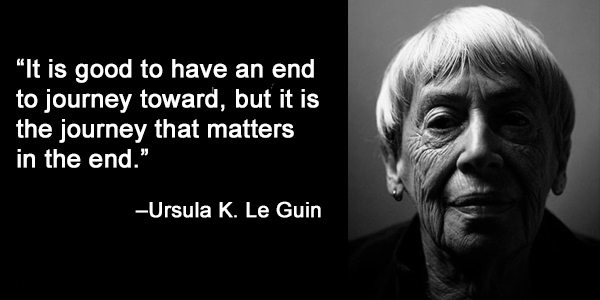
Women’s History – Women Writers

le-guin-1

Protect the Process…

processDan Brown believes strongly in protecting the process.

By process, he means, the writing schedule and habits that create the difference between a writer who produces and the writer who does not.

This has become personally important to me; and lately it has come to my attention that there’s more to protecting the process than just showing up.

It’s about protecting yourself from the negative forces that affect the writing.

We are often disturbed and distracted by people and events around us. I’m not talking about the road raging driver or ineffective salesperson- we should never allow such an insignificant person or event to affect us at all.

I believe we have to prioritize who and what is important – they come first in our lives either before, after, or within our process. The rest of the world must fall away.

I don’t make appointments during my writing time. That has become a habit for the last some years. However, I have allowed other things to interrupt my life, things I thought were vital. This is mostly due to what is expected of me as a social, agreeable person. Lately, though, I’ve realized do have a choice.

I don’t care if I come across as a little anti-social or less agreeable. I’m protecting myself from people and events who will affect my time, writing, and state of mind.

I used to see a writer regularly arguing with others on social media. I asked him why he didn’t just ignore these people. He said it didn’t bother him, they needed to be taught a lesson.

Recently, he deleted many of his social media accounts and limiting his time on others, telling his followers that all the interactions were causing him distress and he hadn’t been able to write.

I’m not only talking about social media, but the regular, sometimes expected, social interactions we have. If they are draining, why do we take part in them? Expectations? Do we get anything out of it?

If not, then rethink it.


Cut Down to Build Up

brain.jpg

Some of the smartest people in the world cut down on their decision making in order to save their energy for creativity.

Einstein owned four brown suits, all alike. He didn’t want to waste his energy on choosing clothing.

Mark Zuckerberg, it’s said, dresses down to save time and energy for the important things.

I, personally, sometimes barely get out of my PJs before I begin my writing – and you know what – I get more writing done!

One writer I know said she refuses to put on make up or do her hair because writing takes precedence.

We don’t need to abandon all our comforts and regular healthy habits in order to be creative, but our energy for decision making could be more balanced and save more preserved efforts for our projects.


Memoir is Not Revenge – The legality of using real names.

memoir


When I started writing memoir, someone said they had no desire for revenge and so they would never write memoir.

But memoir is not about revenge. And you shouldn’t write memoir to get revenge.

Basically, it is believed, a writer can use an actual name of a real person because we all have our points of view and, if they disagree with yours, they can write your own.


HOWEVER, consider these things:

  1. Why do you feel the need to use that person’s full name? Is it for revenge?
  2. Don’t give enough information so any reader might contact them. All you need these days is a name, city, and google.
  3. Do you feel so strongly about using their real name that you want to face a possible lawsuit; whether or not they will win, they may be granted a day in court.

In the memoir pieces I’ve written, I’ve made minor changes to names. This gives anyone in the piece deniability if they’re ever asked whether or not they are the person in my writing; as well, it doesn’t necessarily point to them, and I am able to defend myself should anyone be looking to sue me. Or, in other words, I have deniability.

Inspire

joyce carol oats