Thanks, Darrell!
Check out SnowFlakes in a Blizzard

If anyone would like a free audible copy – let me know by commenting below. First two people only!
Thanks, Darrell!
Check out SnowFlakes in a Blizzard
If anyone would like a free audible copy – let me know by commenting below. First two people only!
This week for the friday feature, I thought I’d offer tips on Submitting.
Last year, I had 17 or 18 publications. This year so far, I’ve had maybe 9 or 10 acceptances. I must be doing something right. 
I think it should go without saying your work should be free of grammar and punctuation errors. I heard from one writer who was offended by an editor; her response: “I know I had errors, but they weren’t that bad.” – No excuses. Edit that work before you send it out.
First: Make a regular time to sit down to submit. This takes HOURS. It’s not going to be just a fifteen minute or thirty minute venture. You must read what the lit mags are looking for as well as how they want it submitted. Then compare it to what you might have already written, or what you’re willing to write.
Second: Keep track of your submissions. 
Third: Accept rejection. (It tells me that I’m doing my job by submitting.)
Fourth: Accept criticism. You are going to get opinions. Just today, I received a rejection that said I repeated a word. That was the whole of their rejection. The word in question was repeated twice in the whole story, but I guess they didn’t like it. I moved on.
Fifth: If they ask for changes – agree (maybe). I’ve met many writers who take issue with this. They wonder if I don’t care about my work. They think I’m mad for even considering it. There are some things I won’t change. But, so far, the editors who have asked for changes have asked for simple things like rewrite this sentence, change this punctuation. No one has asked me to make major changes to any piece I love.
And Finally: Be considerate to writers, editors, and publishers in emails, on public sites, and anywhere you may meet them. When you act inappropriately, word can get around.

Someone asked me if I write what I know. For many, that would be limiting. We write what we know in some intuitive way, like people, emotions, relationships, and some places. But that’s not all we write.
Nothing adds to a story like those little details that you’ve experienced, like the slick, moist, near sickly feel of your skin on a humid day in Paris after emerging from the chilled underground of the catacombs.
The difference in squeezing the smooth texture of black sand from Punaluʻu Beach in Hawaii between your toes and walking on fine, compacted white sand of the Whitsunday Islands in Australia.
 Every beach is just a little different. Just as the light is, depending where on the planet you stand. Being there helps.
But, research is also necessary. Maybe not to describe the sand between your toes, but other important details about place. Incorporating the general details or impressions as well as the smaller, more personal elements creates a more vibrant and more relatable to readers.
Stephen King thanked his research assistant and stated he met a lot of nice people in Oklahoma where his new book, The Outsider, is set. Experience and research.
Many of us can’t fly to Darrien, Washington and spend a week or longer researching a small town setting in the pacific northwest, but we are able to view maps, read the newspaper, follow the instagram sites, ask travel groups and even call the travel bureau in any given state.
I love experiences – Traveling and getting lost in a new place, picking up those sensual memories to infuse into writing and future!
Experience is a great thing, but it’s not the only thing. Research back ups and fills out details we may have missed.
Where have you been that you’ve written about?
Happy Writing!

Many years ago, in a suburb north of Los Angeles, Eat My Cupcake was in danger of becoming another victim of the gluten-free, sugar substituted society when Zin stepped in.
People wanted choices, she said. Eat my Cupcake changed to Eat My Muffin and featured exclusive, secret recipes that other bakers tried to duplicate but none succeeded; the some sweet, some savory, some healthy, some masquerading as healthy became a much sought-after experience.
Therefore, in the once nondescript neighborhood with the small bakery, lines around the corner formed beginning early each mornings, people waiting for the one and only Zin’s famous muffins.
Among one of the favorites was a Millet Muffin. The savory-sweet combination of light and fluffy grain pastry was a hit. 
Zin was offered money, lured by head baker guarantees at more established places with promises of salary, health insurance, assistants.
But she liked where she was, who she was, and the freedom to create.
Rob became Zin’s lover years before she became almost-famous. Rob followed her from place to place, always a second to her baking but accepted the position. They loved each other.
But more hours meant more workers meant more people in Zin’s life. Zin had two weaknesses, fresh white flour and sweet young flesh. She slipped into an affair with one of her assistants, Rob was heartbroken and angry.
 One night, crying over a tequila sour, the recipe came out in a drunken slur. Friends who sympathized turned for a single moment to make a note.
Zin begged forgiveness and agreed to work fewer hours, no assistants. Rob forgave her. He barely remembers his drunken night but thinks something may have slipped. Zin is blissfully unaware that her recipe is being shared in whispers like a friend’s quite insinuations.
What follows is the rumored recipe from a once famous bakery and a once famous baker.
Millet Muffins
½ cup of millet
1 ½ cup of flour
1 tsp baking soda
Dash of salt
½ – ¾ cup of brown sugar
1 (room temperature) egg
1/3 cup of butter (room temperature)
¾ cup of buttermilk (room temperature)
Mix the wet ingredients
Mix the dry ingredients
Oil the muffin pan/preheat the oven to 375.
Mix the wet and dry ingredients together and place the muffins in the oven.
Bake for 18-20 minutes.

*Based on a true story. Names/places changed.
To the best of my knowledge, this is the original recipe. Although I have not baked them myself, I’ve been the beneficiary of the final product. Mmmm.
There are two lessons to this story. First – don’t cheat on your partner who may have your secret recipes. Second, don’t trust a writer with your stolen secret recipe.

Napccident: when a person rests their eyes
and unintentionally falls asleep. The napccident
may last anywhere from five minutes to two or more hours.
I read an article that stated mental and physical exhaustion are different and that those with mental exhaustion nap to re-energize. Writers are, sometimes, prone to mental exhaustion. We are excited by our writing, then we crash. Or, those days when writing is torturous, we want to crash.
Another article stated that naps are ways to procrastinate.
Both are true. I’ve rested to recover from a challenging writing day, and I’ve definitely taken advantage of interludes as a means of procrastination. However, when I’m excited about my project and it’s pouring out, I rarely pause. I even have a hard time sleeping at night because my mind is alive with story.
When I get stuck on a piece of writing, a plot point, a character, I use respites to help me overcome that difficulty. By being still and allowing my mind to wander within the story, the challenge is overcome.
Decide if your napccident is avoidance behavior and make it be productive for you.
In yoga, we set intentions. If you lie down or close your eyes to procrastinate, accept that behavior and set an intention to be more productive. It’s not the pressure of a goal or promise, but it’s an email to your unconscious to get back on track.

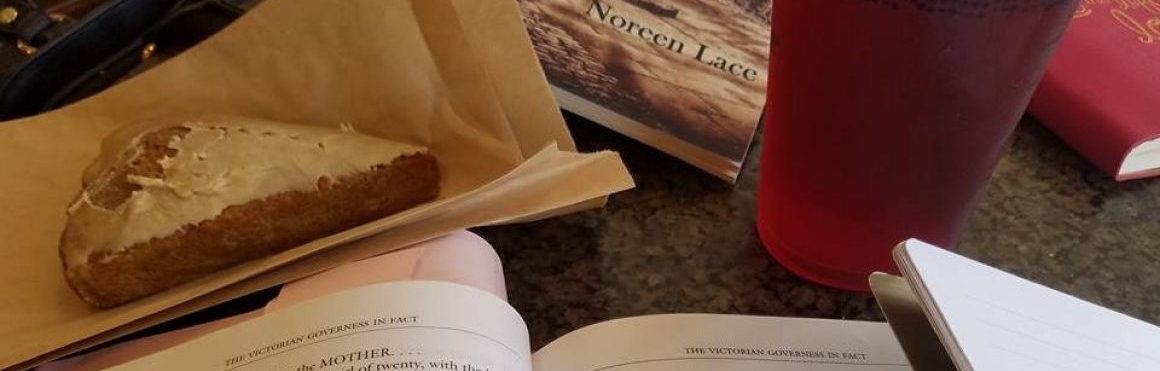
I’ve been thinking of coffee shops. And it’s not only because I’m a caffeine addict. Coffee and coffee shops are a part of our everyday lives and, therefore, our characters’ lives. What type of coffee shop and what they order will inform our readers of who they are in ways we won’t need to spell it out.

I, personally, savor that first sip of morning tea. For a few moments, it’s the perfect temperature and I hold it close to my face, ready for the next sip as the first drips of bitter black tea warm my throat and my body, the caffeine going to work immediately to bring me to full wakefulness in anticipation of a busy day.
A friend described a man in her carpool who stopped every day at Starbucks for a large quadruple espresso latte on their way to work and on their drive back from work. But, she added, he also complained constantly about his budget. This told me a lot about the person in just a few sentences.
Does your character rush into Starbucks and curse the line? Probably orders ahead for pick up, but what if it’s not there? Or is your character the kind that seeks out the independent coffee shop because it may be less busy or just because it’s independent.
There used to be a coffee shop on Ventura Blvd between Hazeltine and Woodman. I don’t  remember the name, but I do remember the walls were pink. I liked it for it’s small town charm. Local home made jams lined the shelves behind me while local artists’ paintings adorned their walls. They only had a few wooden tables, a few more outside, and a few bar-type seats at the counter. Instead of the iced black or green tea choices at you-know-where, I opted for their daily choices, which might icled iced peach or raspberry-ginger. They offered an array of vegan or gluten free cookies as well. Who could resist?
I used this coffee shop in my story “Harvey Levin Can’t Die” (originally published in Pilcrow and Dagger Sept 2016). The story really is about change. How society reflects the  individual and how the individual internalizes society. One of the characters worked there, but felt out of place. This also represented her life, she felt out of place and hadn’t really begun to make real decisions about who she was or what she wanted. But, of course, that changed and so did her involvement in the coffee shop and the guests as she becomes more proactive in her life. The reader is left to decide the interaction between her and society and whether the influence is good or bad.
It would have implied something different about my character if she’d worked at a chain coffee shop. The chain itself would have had an influence and been a foil. She wouldn’t have been able to grow and and the readers couldn’t see the change within the coffee shop itself; therefore, the setting was important in that instance.
Each place, each chain, is different. The people who go to the local Coffee Bean and Tea Leaf Company are different than those who go to Pete’s or even Starbucks. As writers, I imagine we’ve all spent time in these places. And our jobs as writers are to observe. Beyond the color scheme and coffee served, there’s a different atmosphere garnered by and at these places, and the people are different or act different.
I rarely see the impatient phone-bearing customers from the Monday morning Starbucks run at Pete’s. Nor do I see the more relaxed culture of the Pete’s “give me the multi-grain scone and flipped macchiato” at Coffee Bean.
 I used another independent coffee shop for “$1.00 Stories” (originally published in The Chicago Tribune’s Printers Row Journal April – 2016). A mixture of independent coffee shops, one of which still squeaks by in the recesses of North Hollywood. I wanted a friendly owner and regulars my character would recognize. Not that he cared about them; it was more important for the story that they were familiar with Cris, and they accepted with good-natured-humor his occasional weirdness. I didn’t want to make him completely unlikable. I wanted him to come across as a little more complex, so he went to this coffee shop where he knew the owner and sneered at the community table while the regulars chuckled.
The joy I get from using independent coffee shops (or even invented coffee shops) is that I get to describe them, which will also tell us something about the character. In “Harvey Levin”, the character hated the pink walls. But using a chain also tells us something about the character.
Our characters are going to need caffeine at some point in the story. Giving the reader their choice of coffee shops, even in one line, gives the reader an insight into the person we’re creating.
Now my tea’s cold. But I don’t own a microwave and that never tastes good anyway.
Harvey Levin Can’t Die is available on Kindle and at Smashwords.
$1.00 Stories is available at Kindle and at Smashwords.


 Noreen Lace
You must be logged in to post a comment.