6 Reasons Self-Publishing Beats Traditional Houses and Agents – Guest Blog by John Grabowski

For most writers, getting a contract from a traditional publishing house is the golden biscuit, the grand reward after a struggle with run-on sentences, superfluous commas, and tired clichés. Many people will then spend years looking for an agent, and then have an agent try to place their work with a publishers, big or small.

But here’s reality: unless you’re J.K. Rowling or Stephen King, you’re almost certainly not going to receive the red carpet treatment you’re no doubt envisioning. Once upon a time, not a long time ago, self-publishing was considered the literary outback, the place for hacks. Now, in an ironic twist, we just may be witnessing the reversal of fortune. The Bix Six seem to be wallowing in their formulas. Meanwhile, much fresh thinking is coming from self-published authors who build their followings online. So rather than wait for your genius to be appreciated, here are six reasons you should consider being self-published:


  • You are your own editorial voice. While every self-published work should go past the eyes and red pen of an experienced editor, ultimately you can write and publish what you want. You don’t have to deal with an editor or agent who wants a happier ending, a younger protagonist, or the locale moved from Pittsburgh to Paris.


Your hired editor may suggest changes, and you should listen. But ultimately you stand or fall on the product. You won’t have to deal with the agent who refuses to read a manuscript because she never looks at anything that begins with dialogue, or one who says she won’t consider a novel written in the first person, or one who says the work cannot have a “Prologue” or an “Afterward.” Ask yourself if a reader ever put a book back on the bookstore shelf for any of those reasons and you’ll begin to see how silly and random the process can be.


  • You set pricing and distribution. Ever wonder why some really great book has not been reissued, forcing you to buy a beat-up second hand copy? The publisher decides distribution, pricing, and how long the title will be in the catalog. If they don’t want to keep it in their catalog, there’s nothing the author can do.


With self-publishing, your works can live on forever. Or, if later on your freshman effort embarrasses you, you can make it disappear with the click of a mouse.


  • You control the book’s cover design and artwork. This may be intimidating for some but it’s liberating to me. While some professional cover designs are great, others are simply terrible: a stock photo, the title centered above it, the author’s name beneath it. Not surprisingly, artwork like that tends to go to the lesser-known and novice authors.


If you’re unsure how to design a cover (and it involves a lot more than putting your title over a picture and your name on the bottom), google some freelance artists who do it. Study their work and contact the ones you like. If you don’t want to shell out the cash, and you have access to some design tools yourself, find covers of comparable works and study what you like, then try to imitate it as best you can.


  • You can fix mistakes. Even some very big, very famous novels have typos in them. Or formatting errors. When it’s your own work you can go back and fix the mistake, then re-upload the file. With traditional publishers, your mistakes remain, oftentimes even in second and subsequent editions.


  • You promote your work the way you want. Don’t think being published by a big house means jaunts to NPR interviews and author events at prestigious venues. Most houses do nothing to promote the majority of their authors. You have to do your own marketing and PR (an art in itself), so you might as well own and control what you’re working so hard to promote.


  • You can write the next novel you want. The curse of traditional publishing these days is even if you are a smash hit, they will want more of the same. If your goal is to write a second novel that’s different from your first, you may find doors shut to you. Despite claims on websites that agents and editors are looking for “fresh,” “new” voices, most are really chasing trends; that’s how they keep their jobs. Self-publishing is a wonderful opportunity for you to be you, and today’s self-published books look every bit as good as the product of the Big Boys. Rather than write your one-hundredth query letter, why not consider a faster, more streamlined way to reach readers?


John Grabowski worked in advertising, television news and public relations before daring to write his first novel. Entertaining Welsey Shaw was praised by Kirkus Reviews for being witty, fast-paced, and “filled with flirtatious banter.” A collection of his shorter fiction, Violet Rothko & Other Stories, will be published in September 2019.  authorjohngrabowski.com

____________________________________________________________________________________


Thanks, John!

noreen

On my bookshelf

I’ve finished my Tana French detective series and didn’t want to go to bed without another book in hand. (Nevermind there are three on my bedside table).

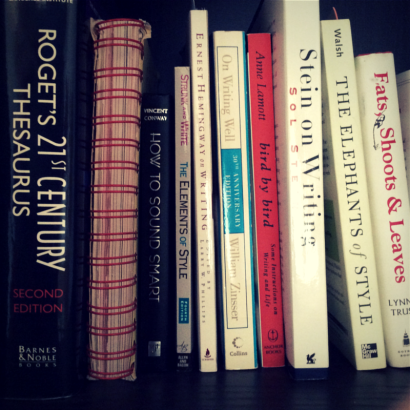
bookshelf.pngI began browsing my bookshelf, which is semi-organized: books I’ve read and loved. Books I want to read. School books. Writing books. and, of course, Poe books

I also have something mixed in that would seem, at first glance, not to belong. Books on psychology, the law, philosophy. I assume many writer’s bookshelves are this way.

A writer needs a wide variety of knowledge.

I know we have google at our disposal; however, I find reading books about, for example, the Psychology of Marketing allows me to get an in depth look that a wikipage or a few short articles are not going to give me. This allows me to create a more realistic character or more thorough background to make the story more believable.

For West End, I needed to understand two things, the idea of an absent or unloving mother, and the different forms depression can take. Anxiety runs throughout my work from Of Strays and Exes to Life of Clouds – which features children affected in different ways by the disappearance of their father.

I’ve heard handymen say they are the jack of all trades. I think writers are akin to that. We need to learn many things in order to live many lives.


Blocked? How to shake it loose.

wall-art-2852231_960_720

Creative blocks are brought on by various reasons.

Writers, poets, artists, musicians need to express themselves. Sometimes, something plugs our flow of creativity.

My friend and I have found release in other creative outlets. She took a watercolor painting class. She feared, at first, that she was taking away from her writing; however, what she found is that it opened her flow and she felt even more creative and was able to add even more to her usual creativity.

I take art and other classes on a regular basis. Most of the time their directly related to writing, but sometimes they are not – but they still feed my imagination and add depth to my writing.

The Healer’s Daughter will be released on May 15th in The Ear. This story came pouring out after a six week drawing class I took at a local museum/gallery. And… I feel like it’s one of my best, filled with color and meaning.

Shake something loose by trying another outlet. You may come back stronger and more creative than before.

Not writing scares me….

ghostly.pngWrite what scares you…..

This is a poetry prompt given to me in one of my graduate level classes.

I don’t think it has to be just for poetry.

Experts tell us we should do something that scares us every day. I don’t know. I’ve done quite a lot of things that scare me – crossing the highest bridge in North America, swimming with sharks, – but those are kinds of scary that gives you a rush. Still valid to write about.

But in that assignment and poem, I wrote about a missing girl. Because those are the types of things that do scare me – when children go missing.

I wrote:

Have you seen her pass this way?

Shoe found, white.

Blood on the laces….


Write about what scares you….


Feel free to share!


Are you a rule follower?

rules.jpgJudy Blume recounts a story in which she took a writing for children class and they set out the rules involved in writing for young children, then she went and broke all of them.

Rules have purpose, have value. They give us the basics.

Hear me out on this – I believe we need to know the rules. We don’t need to necessarily continue to follow the rules.

Picasso followed the rules. But when he was comfortable and confident, he broke them in order to develop his own style.

Every writer should know the rules of writing. Even if they choose not to follow them.

Weathering the Storms

weather-storms-thumbnail

Is there anything worse than a bad review?  Probably, but we don’t think so when we get one.

But ask yourself why you’re upset.

1. Is there some truth to the review? No – then forget it! Yes – then what is it?

One woman relayed that her one star review mentioned grammar and punctuation errors. She said, “I know there are some, but there’s not that many!”

It seems she knew she put out work that was not of a superior quality; she can’t be upset when someone calls her on it.

2. Is it someone who just wishes to malign you? Accept that there are going to be haters. Everyone has them. Remember this quote: “Well behaved women rarely make history.” If someone dislikes you – you might just be doing something right.

3. Someone told me – it’s only the writer who reads all the bad reviews. I think that’s supposed to make us feel better. But it’s true. When you look at reviews, do you search out every bad review there is? or do you read maybe the top five or ten of all the reviews?

I, personally, read a few of each. A few of the five star, a few of the three star, and a few of the one star – critical readers can tell if someone has an ax to grind or if they have real concerns.

Be Gentle

easy

There are times when you have to be hard on yourself.

Then there are other times when you have to offer yourself a break.

Be hard on yourself if you sit around watching television or playing on social media instead of writing.

Give yourself a break if you’re not feeling well.

Be hard on yourself if you allow yourself to be distracted or blocked.

Give yourself a break if you write something that you later have to delete because it doesn’t work.

You should have expectations of yourself, goals you want to attain, and you should attempt to reach those goals instead of sitting around giving yourself excuses not to try.

But things will go wrong; at times, you will fall short of your goals, you will make mistakes – this is the time to forgive yourself.


Defeat Creative Block

wolf.pngGive it physicality.

Give it a personality.

Describe it. Face it. Challenge it. And beat it down.

The Watcher at the Gate by Gail Godwin talks about creative block. One of the assignments I give my class is to draw a picture of what stops them from writing. Some of them draw a picture of an old english professor and some draw pictures of wild beasts. They report, that after giving their block a presence, they are better able to handle it.


Photo Credit

Visualization for Success

Superego

We tell our students to do this – visualize what you want to happen.

Take your visualization a step further, especially if you’ve lost hope or are having a hard time finishing a work:

Create the cover for your book. Maybe slap an award on that cover.

Write a famous person’s review for that book then add quotes to the back cover.

Write the copy for the inside jacket cover.

Hang it or place it on your desk where you will see it every day.

Science says, visualization can help us get to where we want to be!

Women’s History – Women Writers

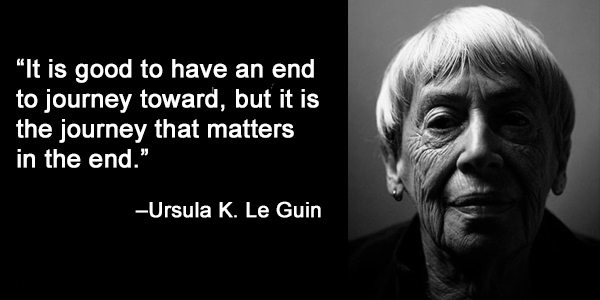
le-guin-1