A Habit of Success

66 days –

That is what a new study says it takes to form new habits.  The study participants reported a range from 2 to 254, with 66 being an average.

writing+ritual+It depends on the person. With me, it takes 3 to 4 weeks for me to stick to my commitment. And every year my teaching schedule changes, so there’s two to three months a year for me to recommit.

The holidays, however, throws many people off.

However, once the commitment is made and the habit is in place, it’s much easier to get back into the mind space. The secret is to jump right back into the habit after a holiday or change.  writing

Also, I think you have to make an effort to guard that commitment. Don’t be tempted to make lunch plans on a writing hour, make it for later or for a different day.

Life too easily distracts us and, without habits firmly in place, we are easily swayed.

The Journey…..

journey.jpgWriting a novel is not a destination; it’s a journey. It’s the hardest journey you will take with unclear signs, narrow paths, tricky u-turns, treacherous cliffs, an occasional dead end, and a steep road toward the end.

You will come out of this ragged, weary, exhausted, and wondering what it was all for. But then, your newborn book materializes before your eyes and you see it was all worth it.

A Tribute to Poe on his Birthday

January 19th, is the 210th anniversary of Poe’s Birth.

poe4Although many people are content with the reason of Poe’s continued relevance in our society is the stereotypical tortured artist.  There is no doubt he was tortured, and for reasons of which we are all familiar; he was an orphan who lost every women he ever loved.

His battles with alcohol, I believe, are highly exaggerated. But it makes for a good story. I’m not saying he never drank – he drank to excess plenty of times, he may have officially been an alcoholic as we understand the word today; however, it was not a constant. There were many years through his marriage to Virginia that he did not drink or drink to excess. Before his death in 1849, he’d joined the Sons of Temperance Movement – to get people to stop drinking.

The reason Poe has remained relevant throughout the years is his work touchespoe our deepest fears and deepest desires. He has continued to inspire other writers
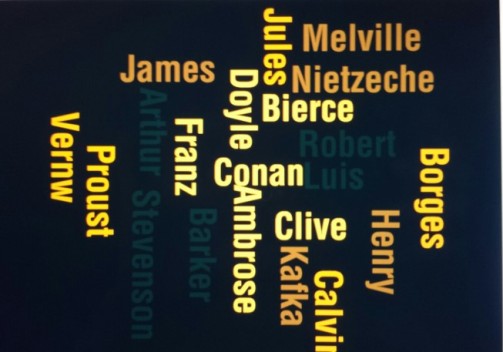


poe2and artists of all types.


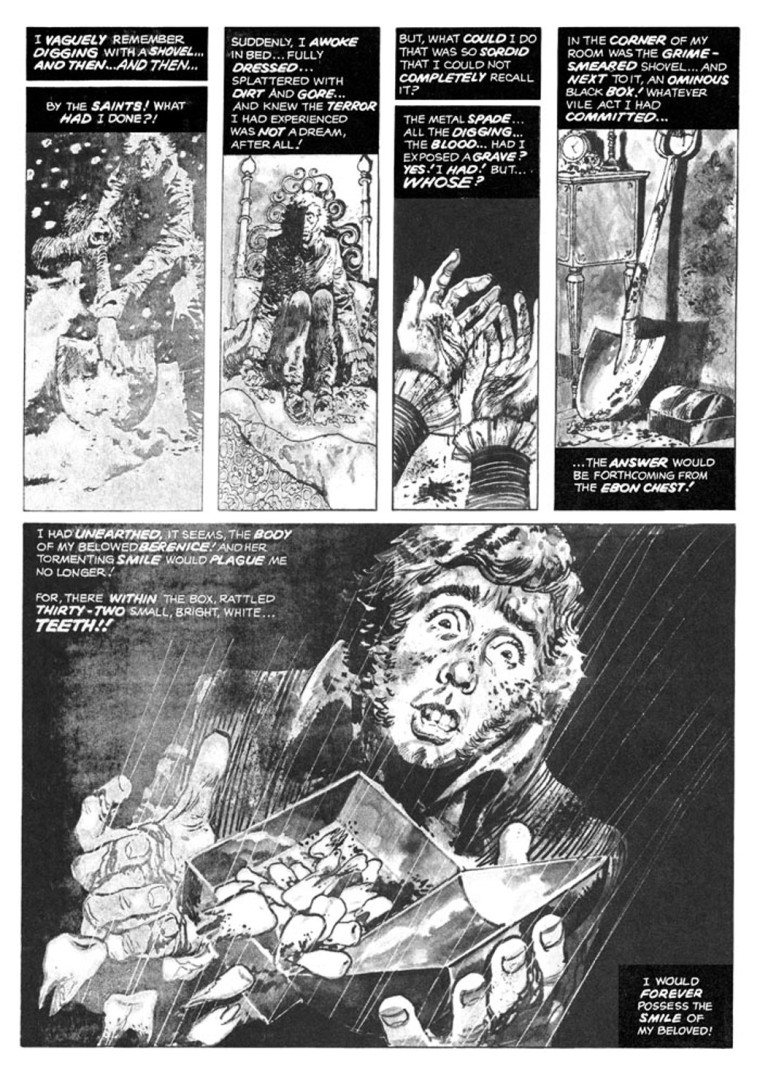
He wrote far more than what we, today, consider horror. He wrote essays, literary analysis, investigative pieces. He wrote about street paving, Stonehenge, and he was inspired by what he read in newspapers.  Berenice and others were inspired by stories of grave robbers in local papers.
poe3

The famed portrait of Edgar Allan Poe was taken three days after his suicide attempt in 1848.

Edgar_Allan_Poe_daguerreotype_crop.png

And, Eddy, my imaginative fiction, was inspired by that suicide attempt. He bought two bottles of laudanum on a cold winter night meaning to do himself in. He’d lost Virginia and felt he had no one. (Laudanum contained opium and derivatives of morphine and codeine.)

eddyfinalredonefromtresized


For Poe’s Birthday, I offer an excerpt from the novella:

   He stumbles from the pub, slips, and falls on the iced over bricks of Boston’s November streets. Save for the muddled voices beyond the closed door, the street is quiet as his body thuds to the ground. His breath billows in front of him as he gasps and grumbles and struggles to his knees, then his feet, to regain his drunken balance.

   The gaslamp on the corner offers a wavering yellow glow for the struggling figure on the lonely winter night. Thin strands of hair blow in the chilled breeze; he runs his hands over his head, straightens himself before he pulls at the sagging overcoat and tugs it closed.

     Remembering the tinctures of laudanum pried from the chary pharmacist, he hurriedly shoves his hands in his pockets, retrieves the bottles.

   His heavy breath mounds in front of him and, for a moment, he can’t see; then the luminous cloud of brandy scented air dissipates. The medicines are intact. Relieved, he stuffs them back in his pocket and buttons his jacket.

   “Edgar,” someone calls from the corner; the noise from the pub trails the swarthy figure out until the door slams to a close behind him. “You alright?”

   Edgar waves him off without turning around.

   The thick shadow chuckles as he staggers in the opposite direction.

   The winter is freezing cold, but the snow hasn’t endured. Small white crystals pile in corners and fill the air. The icy rain soaks him before he reaches his chamber on the second floor of the boarding house. The room is small, impersonal, but warmer than the street. An unlit lantern shimmies on the desk as he unsteadily seats himself, glances out the window.

   A barely discernable outline disquiets the otherwise muted darkness on the corner of the street below. He knows it’s the black dog that’s stalked him his whole life. Suddenly angered, he shoves himself forward, pushes the unlit lamp aside and topples the ink jar.

   “Get outta here, you wretched creature.” The incensed command lost in the night.

      Recovering the secreted bottles of opium from his coat pocket, he sets them side by side in front of him. Unsteadily he tugs the lid from one and snorts in a single gulp.

For More Posts on Poe – click this link.

To get the book at 3.99 – this weekend only – click this link.

To get the ebook at .99 – today only – click this link.


edgar_allan_poe_3.jpg


Much love and luck.


Create an Intention Board

Visualization, scientists believe, is important in achieving what it is you desire.

If you’re concerned about an interview – picture it first

Concerned about completing an assignment? – visualize it finished!

What do you want to happen in the near future?

MOODBOARD2.jpg

Sometimes these are large goals – end result goals, and that’s good. We see the big picture. What about the little picture?

  • Cut pictures out of magazines (old school) or collect images, text, videos from online and make an intention board for the next few months.

This deals with a little bit of realism. If you’re not writing and you choose a photo of you at a book signing, that’s the end result. Perhaps keep that photo, but put it on the larger board.

  • Right now, make an intention board smaller. If you’re not writing and you’d like to write more, place a photo of a person sitting at the computer or typewriter. Imagine what else you want there. You a steam cup of tea? A tray of snacks? Your cat purring at your side? Make this an enjoyable experience. What needs to be there to make this as enjoyable as possible.

I’d love for you to share your results in our newly formed group: Writing 365. Join us!

Food Crimes: Gifting Times Two – Ethnic Recipes from my Friends.

john

Some years ago, John Voso Jr. put together a cookbook, Italian Recipes from my friends; the proceeds from which went to the Richie White Fund. Richie White was a young boy who spent most of his young life in the hospital battling cancer. He lost that battle a few days after his fourth birthday.


This year, John has put together Ethnic Recipes From My Friends. The proceeds benefit a number of good charities.

20180818_163559(0)


The book contains JackFruit tacos. You’ll remember that some months ago, I tried JackFruit tacos at a vegan restaurant and loved them.


43531062_2191834697807633_2971797741660798976_n(1).jpg

When John Voso, his wife, Debbie, and myself met for dinner, I was surprised to find this recipe in the book! I, personally, can not wait to make them myself.


The book contains recipes from a number of different people and cultures:

Angel Wings from Poland, 45249898_10215606113699519_8495535016174944256_n


Sonoran Style Carne Asada, 44957040_10215568156710618_4786004417256095744_n


42876531_10215381572126120_7345769895918829568_nand don’t forget about dessert, A Nut Kuchen!


Ethnic Recipes from My Friends will make a great gift and it supports great causes. Contact John Voso to order your copy!

45697053_10215631174366020_4530526997847212032_n

Writer Wednesday: Can the Can’t!

cantI don’t like the word “can’t.”

I don’t like people telling me I can’t do something. I’ve experienced some person  or another throughout my whole life telling me I can’t do this or I can’t do that. For too many years, I believed them.

Now, it just annoys me.

I made a goal to write six short stories in a month. Someone, another writer, said, “You can’t do that.” Their point: writing must organically develop from inspiration, forcing it unnaturally would create work which was unpublishable.

Three of those six stories have already been published. Can’t? HA!cant2

I spend time on photography, just because I like it. Unasked, another person inserted their opinion: “You can’t do that!” They had the idea that a person can only be good at one creative pursuit and I shouldn’t waste my time on another. I took up photography for the pure joy of capturing visual beauty, but I’ve had a number of photographs published now too!

Why are people so wrapped up in “can’t”?

Some people judge themselves based on how they know you. When you change or move forward or do something they never thought you would or could, it changes how they see you and, therefore, how they see themselves.

cant1Others have limited views of what they can accomplish and, therefore, what anyone can accomplish, so they believe their guiding you away from an upcoming failure.

Whatever their reasons, never let anyone keep you from spreading your wings, doing what you want, need, must do to achieve what you want.

Writers must be brave. Depart from the naysayers and live your fullest life. Travel. Love. Experience. Write. Try something new.

Do not listen to the “can’t”!

cant3

Friday Feature: Timothy Savage on Going Places

time3When people ask where I’m from, I give my prepared answer. ‘Not really from anywhere. Seems like I’ve lived everywhere.’

And that’s true. Over my half-century of time, I’ve lived in Nebraska, Chicago, Minneapolis/St. Paul, Kansas (Overland Park and Lawrence), Seattle, back to Minneapolis/St. Paul, Providence, San Luis Obispo, and the city where I currently reside, Fresno, the fifth-largest city in California (behind Los Angeles, San Diego, San Jose and San Francisco, in that order) and the largest city in the United States disconnected from the Interstate Highway System.  I like to claim that at this point, I’ve made nearly one lap of the country. Map it out and my path becomes a curious zig-zag that seems to alight nowhere and puts down roots only in memory.

That current spot Fresno isn’t exactly scenic. We’re kind of flat and agricultural, and if it tim5weren’t for triple-digit summer heat, certain sections would be indistinguishable from the desolate wilds of North Dakota. It’s so non-scenic that literature has more or less left it out, too. Need proof? A Goodreads count of books set in California is nearly 600. But books set in Fresno? Three. One by William Saroyan, better remembered here as ‘That Famous Guy Who Used to Ride His Bike Through Fresno’s Tower District.’ The second is ‘The Abortion’ by Brautigan, destined thanks to the area’s politics to be a non-seller. The third is by a guy who teaches journalism at Fresno State.
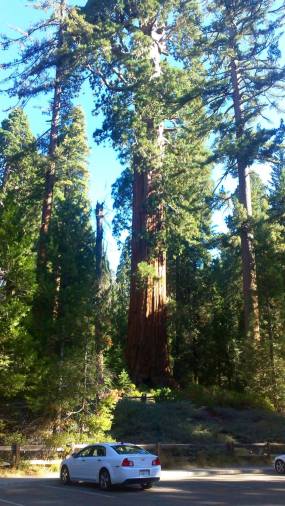
But despite being a setting apparently unworthy of literature, Fresno does have one advantage: It’s a quick two-hour drive from legendary settings. Yosemite. King’s Canyon. The majestic Giant Sequoias. Beaches along the Pacific, including my favorite, Avila Beach.  If you’re feeling ambitious, you can invest an extra hour in that drive and — traffic willing — be in the Bay Area waiting for the ground to shake, or in Hollywood practicing sidewalk astronomy. So Fresno tends to be one of those places people pass through on their way to places far more interesting.

tim1But I suppose I’m grateful that living here encourages travel, even if it does so in a backhanded, better-off-getting-outta-here sort of way. That urge to hop in a car and see something else, that desire to book a plane ticket and go even farther, is not only great for the soul, it’s great for my writing.

I’ve lived here for more than 12 years, and aside from an occasional drive to Avila for some seclusion in a hot tub, full-time work-at-home Dad Duty kept me from traveling much for those first seven years. I’ve made up for that drought over the last few years, though. First a memorable trip to see the sights in Chicago with my son when he was only eight, where we braved the Willis Tower’s ‘Ledge’ and walked the Magnificent Mile together. Then a three-generation trip to Washington D.C.  — myself, my son, and my father, where we explored the sights of true democracy while plugging our ears to my father’s Faux News talking points. Next, two very memorable trips — one solo — to a place I find more inspiring than any other: the southeast of England, where people very dear to me make me feel more welcome than anywhere else, to the point where I call them ‘my English family’ most sincerely.

Being a shutterbug, my other travel trick is to photograph everything. You know that guy tim2with the DSLR strapped around his neck, taking shots of everything from the loo signs to the historical plaques set across monuments managed by the National Trust? Yep, me. Those photos come in handy during the writing process, too. Need the feeling of ‘being there’ recreated? Go visit the photo album. Need to check a historical detail? Dig out the plaque pics and read the answer. Need to remember exactly what order the Roman gods appeared on a bas-relief at the Adler Planetarium? It’s right there in the photo.
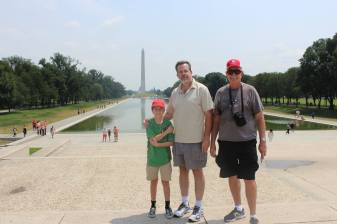
time4As a writer I carry those places with me, and whether I want them to or not, they find their ways into my writing. My Nebraska origins find a home in my writing as Kolej, a small town with a big dark secret in my coming book ‘Lillie Augustine.’ Minnesota and Providence figure prominently in my memoir about full-time fatherhood, titled ‘One Ugly Mother.’ That memorable Chicago trip finds itself in another draft titled ‘Fortunate Consolation,’ where a father leads his special-needs son on a journey to escape the trickster Goddess of Fate. Two very special places — West and East Hills in Hastings, East Sussex — will soon find themselves adapted as different worlds entirely in a collaborative science-fiction epic. That Pacific hamlet of Avila Beach was the setting for my published novel ‘Davey’s Savior,’ an intimate story set next to the pier on a very small stretch of an epic beach. And Fresno? While the city itself may make me want to be elsewhere, its agrarian nature still found its way into a draft my editor promises will be a moneymaker: the saga of ‘Lifeboat.’

You take your rewards where you can get them, right? So, until I have a best seller, it seems my challenges come in recreating places dear to me in words, and rewards through memories made in unforgettable places. With a little luck, I’ll make them equally memorable for my readers. Because after all, what is a good book if not a zig-zag journey that takes root in your readers’ hearts?


Timothy Savage – Author of Davey’s Savior

~~~~~~~~~~~~~~~~~~~~~~~~~~~~~~~~~~~~~~~~~~~~~~~

Thank you, Timothy. I wholeheartedly agree!

noreen

Writer Wednesday: Ode to Professor King

king1


“Most of what writers write about their work is ill-informed bullshit.”


You gotta love Stephen King, if not for his fiction, for the way he sets things straight and to the point.

This is the line that begins King’s rewrite for his novel The Gunslingerking4, originally released in 1970, rewritten and rereleased in 2003.

He rewrote and released the novel – only Stephen King could do that.

In any case, I found his forward notably valuable. His words are not only ever for his readers, but for writers as well.

His approach to revision he says, “hasn’t changed much,” and it is “to plunge in and go as fast as I can, keeping the edge of my narrative blade as sharp as possible through constant use…. Looking back,” he says, “prompts too many questions.”

I agree. I’m one to power through and not consider edits until I’m completely finished. This way I don’t get hung up wondering if this is right, if that flows, should I change this word here? Nothing is finished until the end is on paper, then comes the time for change; however, King puts his work away for a time. I, personally, give it an edit or two or ten. I give it to my friends, I reread, fawn over every word, sentence and…. it still has errors I don’t catch for six months or a year.

king2For the original writing of The Gunslinger, King has this to say about his younger self, “too many writing seminars, and had grown used to the idea those writing seminars promulgate: that one is writing for other people rather than oneself; that language is more important than story; that ambiguity is preferred over clarity and simplicity…”

I was once in one of those very seminars when someone brought up Stephen King, “don’t worry,” the professor announced, “he’ll never be remembered in the annals of history.”

The same professor, the same class, a few sessions later, eyed me after my story had been workshopped and discussed. “I’m still trying to figure out the reason for writing the story.”

“I think,” braved another student, “she wrote it for pleasure, for publication.”

The Professor’s eyes narrowed, her lips thinned, and she sat forward in the old wooden desk, “we don’t do that in this class,” she hissed.

My nervous smile slipped away as silence rose from our feet up. No one moved. No one breathed. One girl had already run out crying, perhaps they were waiting for me. I didn’t want to cry, nor run out, but I’d felt everything I’d done up til that point undeniably wrong.

I learned to write, over the next few year, the way of the MFA, ambiguous, language king5heavy, story slipping under the covers of darkness of words and rhythm.

Stephen King, I thought then and now, by sheer volume and honesty of craft, will not be forgotten. And I’m not sure he cares one way or the other.

I think we can all learn a thing or two from Professor King.

Friday Feature: Building a Community of Writers – Rebecca Clark

Hi, All.  Today, I asked Rebecca Clark to tell us about The Writer’s Point.

~~~~~~~~~~~~~~~~~~~~~~~~~~~~~~~~~~~~~~~~~~~~~~~~~

fridayfeature


My name is Rebecca Clark. I am the founder of The Write Point, a free social networking community for writers, editors, publishers, beta readers, and literary agents.

Here’s my story.

For the past 15 years I’ve been writing fiction stories. Mainly for myself. It wasn’t until about 7 years ago that I thought maybe I could actually publish something! I wanted to share my make-believe worlds with others. So, I dug deep into the Internet to see what I could find about agents, publishing, the editing process, and what ever else a successful book entailed. I found several forums full of knowledgeable authors.

Forums are messy, in my opinion. I was a brand new writer lost in a world of writers who knew everything I needed to know, but somehow I felt that I didn’t fit in. There was one forum website in particular that made me feel like I shouldn’t be a writer at all. Every question I asked was answered with “google it”.

So, I googled it. I learned so much on my own, but I really just wanted to be a part of a community, some place where I felt at home with people just like me.

Last year, I decided that if I couldn’t find a place to call “home”, I’d create one. So, I did! Fortunately for me, a couple of years ago, I graduated with a degree in Computer Information Systems: Website Development and Design. I could take the time to build upon the idea, and actually understand what I was doing in the process.

The Write Point is a FREE community that I hope will become a place for new writers to feel welcome, and experienced writers can share their expertise without making anyone feel like they aren’t good enough!

Noreen, thank you for allowing me to share the story of The Write Point. To learn more about us, visit https://thewritepoint.com.

The Write Point Facebook page is: https://www.facebook.com/thewritepoint

You can also find me tweeting here: https://www.twitter.com/bekkahclark and here https://www.twitter.com/twp_network

~~~~~~~~~~~~~~~~~~~~~~~~~~~~~~~~~~~~~~~~~~~~~~~~

Many thanks, Rebecca.

Writers, Enjoy!

weekend

Friday Feature – Fantasy for Mental Health by Lara Lee


Today, I’ve asked Lara Lee, fantasy author to write something for us.

~~~~~~~~~~~~~~~~~~~~~~~~~~~~

fantasy2In brainstorming ideas for one of my novels, I decided to research the question: Can a person be immune to brainwashing? We have all seen on television or in movies or even old books the trope of someone being brainwashed to do horrendous crimes against their will. It is overused, so I often stay away from it. My villain just seemed the kind of person to try and brainwash my hero, but I was curious how this worked in reality. Other books have their protagonist resist by the strength of their will. Was that how it is done?

No!

I was absolutely shocked by the research I came across. Strong-willed people were not immune to brainwashing, daydreamers were. Often, those resistant to brainwashing were people no one would expect, average looking people with little to brag about. Why is this?

First, we have to deal with what brainwashing is. Many people over the recent years have argued that true brainwashing doesn’t exist. Just like hypnosis, a person cannot be forced to do something against their foundation beliefs. The term and identification of the phenomenon of brainwashing came from around the time of the Korean War. Prisoners of war were “brainwashed” and then released to their home countries as spies for the Koreans. The same phenomenon was also seen in cults in the US and other organizations. These people did change. They did act in a way that they previously thought was wrong. Something happened to them that changed them.fantasy1

Brainwashing, like the movies, doesn’t happen. People’s thoughts are not wiped clean and then planted with new thoughts, but what does happen is that a person is put in such restrictive environment that denies all basic needs until the point that the person either is on the brink of a nervous breakdown or experiences one. Then the captor offers “kindness” such as water or food and slowly breaks down the victim’s foundational beliefs to those that the captor wants. They are convinced and persuaded under pressure to adopt new ideas. Sometimes these new thoughts stick for a lifetime. Sometimes they only last until a healthy lifestyle is restored. It again depends on the person.

As I read this description, I realized that sometimes life events bring people to the point of breaking, even without a captor. We have all heard of people who suffered emotional breakdowns just from trauma in ordinary living. Deaths, illness, financial struggles, relationship problems produce extraordinary strain. Life can be hard, and at times people break. Depression, anxiety, and PTSD are common. Some people endure a lot in life and stay strong. Some people crumble relatively quickly. So I continued my research wondering how one would fight this mental breakdown. It stopped being about brainwashing and more about mental health. How do we endure high stress without falling apart?

The secret is dissociation.

It turns out, that people who can disassociate from the circumstance that they are in do well. This practice is often taught to soldiers in the military to help in case they are captured and tortured. Dissociation is the process of mentally removing yourself from reality and separating your emotions from your circumstances. If not done intentionally, it can be a psychological disorder, but, when done intentionally, it provides a brief relief from the pain of reality.

To me, this sounds like escapism literature, my favorite being fantasy. We all either have said or heard someone say that they read or go to the movies to “get away” from life. This act of “getting away” is to remove yourself from reality for a time into a fake world. Escapism is often about ignoring the pain of reality to have a little fun, or just to “veg” for a while. Sounds a little like disassociation right?

Not all entertainment is escapism. Some highlight the painful realities of life, but the popularity of the superhero movies, Harry Potter, Twilight, Game of Thrones, and The Hunger Games show that escapism is alive and well. I personally remember in some of the darkest times of my life escaping into books to bring relief to my emotions. I read nearly the entire Dresden file series that had been written up to at that point when a loved one was dying. I was often asked how I survived some of what I went through without shutting down, getting a divorce, or turning to substance abuse. I do have a Christian faith that I depend on, but I think I was also provided a way of emotion disassociation through fantasy fiction that helped me bare the emotions. God is not against fantasy; he told parables himself.fantasy

From the beginning of human history, we have had folklore, myths, legends, and fairy tales. These are the precursor to our modern fantasy fiction. The ancient world knew they needed an escape from the harsh realities of life. The human mind can only handle so much before breaking and caving in. Some seek relief in substance abuse or unhealthy relationships. Fantasy is a place in which you can be the hero and in control for 300 pages. Perhaps you will never endure the type of stress used in brainwashing, but I think we all can benefit from a bit of fantasy.


Lara Lee

The Shadow of the Gryphon

~~~~~~~~~~~~~~~~~~~~~~~~~~~~~~~


Thank you, Lara!