The Ever Popular Tortured Artist…

Is it true, Ms Lace, that all writers are alcoholics?

No.

But they all drink, right?

No.

My blah, blah, blah said that he gets his best ideas and does his best writing when he drinks.


Well, I guess I have heard you should write drunk and edit sober.

Maybe he does that.

photo of alcoholic beverage

I’m not a fan of the stereotype of the tortured artist. Some artists have experienced hardships. There is no need to go seeking hardship in order to be a writer.

It is a waste of time to emulate other successful authors’ negative habits. It’s my understanding it takes a lot of time and effort to build up a tolerance to become an alcoholic or drug addict and still be able to function. Sounds like a waste of valuable writing time and meaningful brain cells – which one needs in order to write well.

Skip torturing yourself, creating drama, hurting others – life is hard enough. Just write.

What makes good literature?

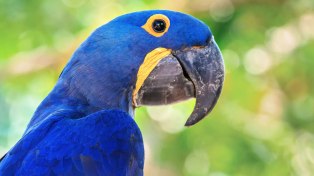
An extremely good conversation in my literature class about intelligence (Inspired by Ted Chiang’s The Great Silence). We talked about other species that fall under the definition of intelligence, which is “the ability to understand and apply knowledge.” parrot.jpgConsidering Alex the Parrot and Koko the Gorilla, and other species: crows are problem solvers and remember faces. We discussed dogs, cats, and others. Is love, as an abstract idea, understood and applied by animals? And then – is intelligence found in showing love?

This is what good literature should do. Teach, delight, and create wonder.

Read The Great Silence here

The Writer’s Eye…

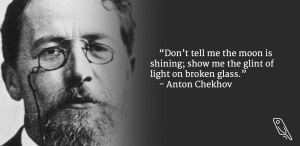
writingquote2

Haven’t read Chekhov? Do so here.

The Writer’s Soul

writingquote6

What’s So Scary?

leaving-your-fears-insecurities-behind.jpg

“Don’t be afraid of failure.  The reality is that most people successes rise out of the ashes of their previous failures.”

From a new documentary on Netflix titled Creativity. The narrator is talking to the creator of Game of Thrones. The creator is talking about how many times he’s failed.

I started this to say – what are you afraid of?

Then I wanted to ask – what if there was no such thing as fear? What would you do? What could you do?

I want you to think about that. What if fear was not in the human range of emotion or thought?


Submissions and Updates

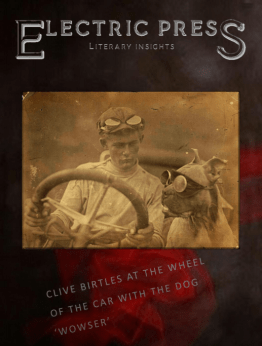
electric press

Do you know where to submit?  There are a number of writing communities on facebook and twitter which post submission calls.  In fact the hashtag #writingcommunity can help you find some too.

I was asked by author and now publisher, Paul White, to submit to his new project called Electric Press.  It has just been published. I’m proud to say I have a short story and two poems within the digital pages.


I was also asked by Jack, from ReadLipsPress to submit (and to share the call for submissions) for Delphinium. Their annual Literary Journal. delphinium accepting submission.png


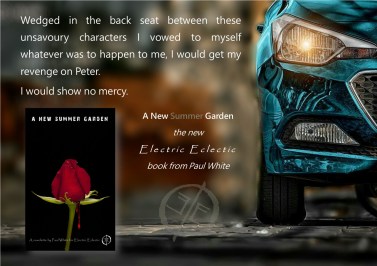
Finally, Paul White asked me to share his good news! The publication of his novella: A New Summer Garden.

A crime drama.

Sam was a down and almost out, NSGprom2.jpgwith little prospect for the future when he meets Rachelle, the beautiful wife of the philanderous Peter, the kingpin of an international criminal business empire.

When Peter catches Sam ‘in flagrante’ with Rachelle, he ensures Sam’s simple life becomes complicated.

What happens next takes Sam on a surreal path, where the only plausible outcome is for Sam to end up in prison or dead… most probably both.

You can find Paul at Ramblings from a Writer’s Mind


That’s it for now, beautiful people. Have a great day!

Write, write, then write…

writingquote7

Alone, in the dark, write

Turn off as many lights as you can bear. Except, of course, a little book light or candle so you can write.

As your eyes adjust, you’ll be able to see things, outlines, shapes; write about the darkness surrounding you, what you can see, what you can’t see, and what you wish you could see.

candle.jpg

Convince that muse…

writingquote3

Dreamcatcher Poem

dreamcatcherThe dreamcatcher is supposed to catch bad dreams and let the good dreams through.

Write down an image remembered from a dream, a word, a sound, a thought, into each space.

Then put them together – or leave them as is.

A dreamcatcher is random. Your poem might be as well. Yet, at some point, some place, in some way, it’ll all come together.