What’s So Scary?

leaving-your-fears-insecurities-behind.jpg

“Don’t be afraid of failure.  The reality is that most people successes rise out of the ashes of their previous failures.”

From a new documentary on Netflix titled Creativity. The narrator is talking to the creator of Game of Thrones. The creator is talking about how many times he’s failed.

I started this to say – what are you afraid of?

Then I wanted to ask – what if there was no such thing as fear? What would you do? What could you do?

I want you to think about that. What if fear was not in the human range of emotion or thought?


6 Reasons Self-Publishing Beats Traditional Houses and Agents – Guest Blog by John Grabowski

For most writers, getting a contract from a traditional publishing house is the golden biscuit, the grand reward after a struggle with run-on sentences, superfluous commas, and tired clichés. Many people will then spend years looking for an agent, and then have an agent try to place their work with a publishers, big or small.

But here’s reality: unless you’re J.K. Rowling or Stephen King, you’re almost certainly not going to receive the red carpet treatment you’re no doubt envisioning. Once upon a time, not a long time ago, self-publishing was considered the literary outback, the place for hacks. Now, in an ironic twist, we just may be witnessing the reversal of fortune. The Bix Six seem to be wallowing in their formulas. Meanwhile, much fresh thinking is coming from self-published authors who build their followings online. So rather than wait for your genius to be appreciated, here are six reasons you should consider being self-published:


  • You are your own editorial voice. While every self-published work should go past the eyes and red pen of an experienced editor, ultimately you can write and publish what you want. You don’t have to deal with an editor or agent who wants a happier ending, a younger protagonist, or the locale moved from Pittsburgh to Paris.


Your hired editor may suggest changes, and you should listen. But ultimately you stand or fall on the product. You won’t have to deal with the agent who refuses to read a manuscript because she never looks at anything that begins with dialogue, or one who says she won’t consider a novel written in the first person, or one who says the work cannot have a “Prologue” or an “Afterward.” Ask yourself if a reader ever put a book back on the bookstore shelf for any of those reasons and you’ll begin to see how silly and random the process can be.


  • You set pricing and distribution. Ever wonder why some really great book has not been reissued, forcing you to buy a beat-up second hand copy? The publisher decides distribution, pricing, and how long the title will be in the catalog. If they don’t want to keep it in their catalog, there’s nothing the author can do.


With self-publishing, your works can live on forever. Or, if later on your freshman effort embarrasses you, you can make it disappear with the click of a mouse.


  • You control the book’s cover design and artwork. This may be intimidating for some but it’s liberating to me. While some professional cover designs are great, others are simply terrible: a stock photo, the title centered above it, the author’s name beneath it. Not surprisingly, artwork like that tends to go to the lesser-known and novice authors.


If you’re unsure how to design a cover (and it involves a lot more than putting your title over a picture and your name on the bottom), google some freelance artists who do it. Study their work and contact the ones you like. If you don’t want to shell out the cash, and you have access to some design tools yourself, find covers of comparable works and study what you like, then try to imitate it as best you can.


  • You can fix mistakes. Even some very big, very famous novels have typos in them. Or formatting errors. When it’s your own work you can go back and fix the mistake, then re-upload the file. With traditional publishers, your mistakes remain, oftentimes even in second and subsequent editions.


  • You promote your work the way you want. Don’t think being published by a big house means jaunts to NPR interviews and author events at prestigious venues. Most houses do nothing to promote the majority of their authors. You have to do your own marketing and PR (an art in itself), so you might as well own and control what you’re working so hard to promote.


  • You can write the next novel you want. The curse of traditional publishing these days is even if you are a smash hit, they will want more of the same. If your goal is to write a second novel that’s different from your first, you may find doors shut to you. Despite claims on websites that agents and editors are looking for “fresh,” “new” voices, most are really chasing trends; that’s how they keep their jobs. Self-publishing is a wonderful opportunity for you to be you, and today’s self-published books look every bit as good as the product of the Big Boys. Rather than write your one-hundredth query letter, why not consider a faster, more streamlined way to reach readers?


John Grabowski worked in advertising, television news and public relations before daring to write his first novel. Entertaining Welsey Shaw was praised by Kirkus Reviews for being witty, fast-paced, and “filled with flirtatious banter.” A collection of his shorter fiction, Violet Rothko & Other Stories, will be published in September 2019.  authorjohngrabowski.com

____________________________________________________________________________________


Thanks, John!

noreen

On my bookshelf

I’ve finished my Tana French detective series and didn’t want to go to bed without another book in hand. (Nevermind there are three on my bedside table).

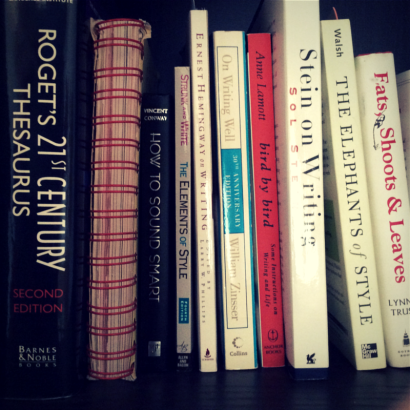
bookshelf.pngI began browsing my bookshelf, which is semi-organized: books I’ve read and loved. Books I want to read. School books. Writing books. and, of course, Poe books

I also have something mixed in that would seem, at first glance, not to belong. Books on psychology, the law, philosophy. I assume many writer’s bookshelves are this way.

A writer needs a wide variety of knowledge.

I know we have google at our disposal; however, I find reading books about, for example, the Psychology of Marketing allows me to get an in depth look that a wikipage or a few short articles are not going to give me. This allows me to create a more realistic character or more thorough background to make the story more believable.

For West End, I needed to understand two things, the idea of an absent or unloving mother, and the different forms depression can take. Anxiety runs throughout my work from Of Strays and Exes to Life of Clouds – which features children affected in different ways by the disappearance of their father.

I’ve heard handymen say they are the jack of all trades. I think writers are akin to that. We need to learn many things in order to live many lives.


Alone, in the dark, write

Turn off as many lights as you can bear. Except, of course, a little book light or candle so you can write.

As your eyes adjust, you’ll be able to see things, outlines, shapes; write about the darkness surrounding you, what you can see, what you can’t see, and what you wish you could see.

candle.jpg

Dreamcatcher Poem

dreamcatcherThe dreamcatcher is supposed to catch bad dreams and let the good dreams through.

Write down an image remembered from a dream, a word, a sound, a thought, into each space.

Then put them together – or leave them as is.

A dreamcatcher is random. Your poem might be as well. Yet, at some point, some place, in some way, it’ll all come together.

The Confessional Poet

writingquote4

Not writing scares me….

ghostly.pngWrite what scares you…..

This is a poetry prompt given to me in one of my graduate level classes.

I don’t think it has to be just for poetry.

Experts tell us we should do something that scares us every day. I don’t know. I’ve done quite a lot of things that scare me – crossing the highest bridge in North America, swimming with sharks, – but those are kinds of scary that gives you a rush. Still valid to write about.

But in that assignment and poem, I wrote about a missing girl. Because those are the types of things that do scare me – when children go missing.

I wrote:

Have you seen her pass this way?

Shoe found, white.

Blood on the laces….


Write about what scares you….


Feel free to share!


Old School Inspiration

Yuself Komunyakaa is one of my favorite poets. He writes about love and passion, loss and war – all kinds of war, including the Vietnam war in which he served many years ago. Although he’ll write about, he won’t talk about it.

One of the many mysteries of poets. Sometimes purging our pains in poetry is so much easier than clearing our mind with conversation.

I love reading poetry because it inspires me. Does it inspire you?


The Soul’s Soundtrack

When they call him Old School
he clears his throat, squares
his shoulders, & looks straight
into their lit eyes, saying,
“I was born by the damn river
& I’ve been running ever since.”
An echo of Sam Cooke hangs
in bruised air, & for a minute

the silence of fate reigns over
day & night, a tilt of the earth
body & soul caught in a sway
going back to reed & goatskin,

back to trade winds locked
inside an “Amazing Grace”
that will never again sound
the same after Charleston,

South Carolina, & yes, words
follow the river through pine
& oak, muscadine & redbud,
& the extinct Lord God bird
found in an inventory of green
shadows longing for the scent
of woe & beatitude, taking root
in the mossy air of some bayou.

Now Old School can’t stop
going from a sad yes to gold,

into a season’s bloomy creed,
& soon he only hears Martha
& the Vandellas, their dancing
in the streets, through a before
& after. Mississippi John Hurt,
Ma Rainey, Sleepy John Estes,

Son House, Skip James, Joe
Turner, & Sweet Emma,
& he goes till what he feels
wears out his work boots
along the sidewalks, his life
a fist of coins in a coat pocket
to give to the recent homeless
up & down these city blocks.

He knows “We Shall Overcome”

& anthems of the flower children
which came after Sister Rosetta,
Big Mama Thornton, & Bo Diddley.
Now the years add up to a sharp
pain in his left side on Broadway,
but the Five Blind Boys of Alabama
call down an evening mist to soothe.

He believes to harmonize is
to reach, to ascend, to query
ego & hold a note till there’s
only a quiver of blue feather
sat dawn, & a voice goes out
to return as a litany of mock
orange & sweat, as we are sewn
into what we came crying out of,

& when Old School declares,
“You can’t doo-wop a cappella
& let your tongue touch an evil
while fingering a slothful doubt
beside the Church of Coltrane,”
he has traversed the lion’s den
as Eric Dolphy plays a fluted
solo of birds in the pepper trees.
 

Cento – or Collage Poems

In a writing group, we were challenged to write a cento in a given time from poems we were handed. A fun exercise!

Many years ago, in a writing class, I’d taken all the student poems which had a line or two rejected or criticized for whatever reason and placed them together in a poem. I read this in the same class and our Professor recognized what I’d done and appreciated it.

“UnWalden Pond” was published in That’s Going to Hurt a few years ago.

unwaldenpond.png


Centos are fun poems to write. Some publishers require citations for each line. Some publishers do not. I think it’s probably a good idea to keep notes of where you got what and call a cento a collage, patchwork, or otherwise identify it for what it is.