The protagonist, Bella, is unforgettable — not because she’s perfect or extraordinary, but because she feels real. She’s funny and flawed, vulnerable and sharp.
Readers are able live it, feel its textures, colors, and edges.
What Is Synesthesia?
Synesthesia is a condition in which one sense automatically triggers another. Some people see colors when they hear music. Others taste flavors when they read words. Letters, numbers, and sounds can carry textures, hues, or even personalities.
Artists have long been associated with synesthetic experience. The blending of senses can deepen metaphor, intensify emotional texture, and create immersive artistic worlds. Whether someone clinically has synesthesia or simply creates work that feels synesthetic, the effect on audiences can be powerful.
Why Readers Love Bella
Readers of Bella often describe the book as:
Intimate — like a conversation you’re invited into
Reflective — it asks questions without demanding answers
Grounded — emotions that feel familiar, not dramatic for drama’s sake
Quietly powerful — subtle moments that hit deep
This isn’t a book of fireworks. It’s a book of echoes — the kind that stay in your mind.
Naming characters, for some writers, is a complicated process. They want an original name for their original character. Perhaps they want something that describes strength and power, or maybe they want something that will tell a reader this person is a nerd. Maybe an old name, from their grandmother’s era, to say something about the character or their family.
For other writers, they log on to baby names and search through for the perfect one. The perfect one might be based on sound, consonants and vowels, rhyming, colors, meanings.
For me, sometimes, characters name themselves. The character develops and the name comes. For Our Gentle Sins, Jack’s name came to me like that. But some of the other characters were actually named for the students in the class that I mention in my acknowledgements. I was inspired by that class.
it was January 2017. The world was changing and people, some of my students, were afraid, others were angry. That semester, I was asked to teach the History of African American Literature. The students were expecting another teacher. When I walked in – they weren’t certain what to make of me or what this class might become.
I said – I love literature and we are here to learn together. If I say something or do something you don’t like – you tell me. Later, I was evaluated by our expert in African American Literature. He said, “never have I seen a class so open to talking about gender, race, culture – and being respectful about it!”
That was my rule – we don’t have to agree, but we should learn how to respectfully disagree.
It was a wonderful class.
Our Gentle Sins began just before the semester, I was so inspired that I would write before class as the students walked in and after class as they walked out. They asked me what I was working on – I told them. At one point, they asked me to read them a section. I agreed.
What I told them is that I’d been so inspired by the class that I’d named some of my characters after some of the names in class. Not after the students themselves because I didn’t match up characteristics between real person and student, just their names. They loved the idea.
Many, many times, I’ve had people think the story was about them or that the character was somehow inspired by them. I had, at least, one person (maybe more) stop talking to me because of a character name. I didn’t realize it right away. It was only when I looked back on our messages that I saw the dates and the topic – the story they were about to read. The name had NOTHING to do with them or the friend they believed the character to be named after. It was just a name and it felt right in that place.
The truth is – if I really disliked a person, I would never use their name, not for good guys or bad guys, not for the character who might die or a stray dog gracing the pages. Why would I want to be reminded of someone I disliked? The name might be similar – but it was never about them. It was a character.
Although my students appreciated I used some of their names, none of them felt I’d used them personally as the inspiration for the character.
Our Gentle Sins is about people finding their way in life – recovering from past mistakes. Aren’t we all?
Reviews are so important to the future of our books and our publishing. It’s the first thing customers look for and publishing companies look for when deciding to publish your work. For some reason, it’s difficult to get readers to review on Amazon, GoodReads, or Barnes and Nobel among others.
I get emails, text messages, letters – sometimes I get them through third party systems. And they’ve been sterling. But they have not appeared in any public place.
Please review, review review.
We love personal notes. I’ve had people send me things. How wonderful. I always respond to emails. And I include – please publish this review.
Another wonderful review came in by my good friend, Jo Rousseau.
“Ms. Lace has written a novel that is both gritty and tender. Her ability to create very real characters with very real emotions makes this novel a satisfying read. What makes the short fiction of Noreen Lace stand out is, not only Lace’s facility with language, but her ability to connect with her reader. She lays the soul of her characters at the feet of her readers and it’s impossible not to respond. In her fiction, Ms Lace creates a world of darkness and warmth. Her characters, although flawed, find a way to triumph over the hand fate has dealt them, moving forward and rising up through enormous odds. The journey: there-in lies the tale.”
Jo Rousseau can be brutally honest – she told me numerous times during my writing process when the story wasn’t adding up, needed changes, or didn’t follow to a natural end. So – when she gives me a compliment, I know it’s as authentic as she is.
Once you order you read – please, please write a review. Thank you!
Print and digital copies will be available Tuesday, June 21st!
Thank you for your support!
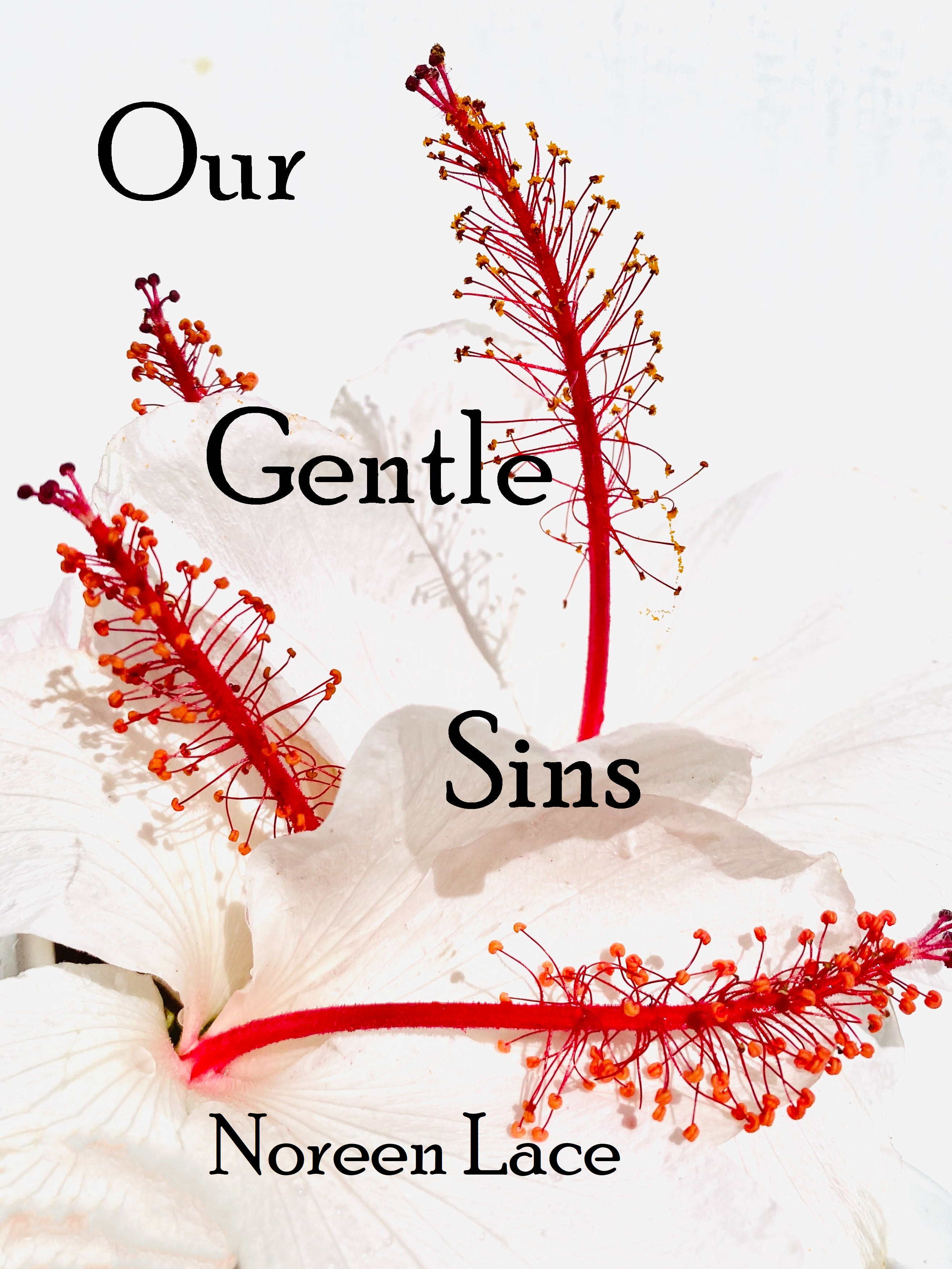
Valerie Graham struggles to solve the growing problems of her new marriage when the full of life, artist and street racer, Jack, comes on the scene. Both her husband and Jack have secrets to protect. But for Valerie, it isn’t just choosing a man; it’s choosing the way she wants to live, who she wants to be. Will Valerie figure out that her life doesn’t have to be determined by a choice between Jack and Alexander before their secrets threaten her?
Our Gentle Sins is a story about recovering from past mistakes. Understanding who to have in your life, when to let go, and how to move forward.
REVIEWS:
“Lace takes a familiar story… and suffuses it with intriguing family drama.” “…energetic prose…” “this is an appealing novel with relatable, flawed characters.” PW
“Lace has woven a wonderful tale with themes and characters that are universal and recognizable. Such issues as a woman’s personal sovereignty within a relationship, the oppressiveness, both subtle and overt, of patriarchy and the mixed blessings of liberation are explored. A wonderful, readable story, ideal for Summer reading. Kudos to Noreen Lace.” Ron Terranova
“Ms. Lace has written a novel that is both gritty and tender. Her ability to create very real characters with very real emotions makes this novel a satisfying read. What makes the short fiction of Noreen Lace stand out is, not only Lace’s facility with language, but her ability to connect with her reader. She lays the soul of her characters at the feet of her readers and it’s impossible not to respond. In her fiction, Ms Lace creates a world of darkness and warmth. Her characters, although flawed, find a way to triumph over the hand fate has dealt them, moving forward and rising up through enormous odds. The journey: there-in lies the tale.” Jo Rousseau
Thank you to my fellow author and friend, Ron Terranova, for his review of my upcoming release, Our Genlte Sins, June 21!
“Lace has woven a wonderful tale with themes and characters that are universal and recognizable. Such issues as a woman’s personal sovereignty within a relationship, the oppressiveness, both subtle and overt, of patriarchy and the mixed blessings of liberation are explored. A wonderful, readable story, ideal for Summer reading. Kudos to Noreen Lace.”
I didn’t grow up with a lot of positive role models. There were not many (if any) people in our neighborhood who were looked up to as success stories.
I can see my neighbors, even now, from the concrete steps of our four unit blond brick building on S*** Avenue in Collinwood. Across the street, Francis. She had Lucille Ball red hair and sat on her porch from 9am to 9pm, beer in hand. Next door, a single mother who worked at a bar and brought work home with her – in all sorts of ways. Next to her, a retired old man who sat across from Francis with his own beer in hand. His wife, Goldie, was a sweet woman whose toes twisted around one another, feet mangled, she said from twenty years of high heeled waitressing. On the other side, a retired railroad worker, no patio, so he sat in his kitchen hand wrapped around a cold beer.
There were bars on every corner. T & M’s could be seen from the porch. Strangers and neighbors stumbling out with the music pouring onto the street.
The teenagers went to high school, married the boyfriends who beat them, and set up house on the next block. A few got away, I’m sure. But I can list many more who died young or ended up in prison. My teenage crushes are dead now. One was shot in the head, the other crushed under the wheels of a truck. I never got into drugs, thought those who smoked and drank acted silly, stupidly, dangerously. Girlfriends recall tales of waking up half naked, uncertain if anything happened. That wasn’t the memory – or lack of memory – I wanted.
Mostly, I felt limited. I felt outcast. I didn’t seem to belong with any particular crowd or group or gang. I wanted something more, something different, and I didn’t know where to turn. Getting out and getting away seemed the only answer for me. I didn’t know what might meet me beyond the borders of the familiar, but there was no safety and no options in the familiar.
Someone once said – it was very brave of you to travel across country on your own and start over alone. I hadn’t considered it was “brave.” I’d believed it was my only choice, my only chance. She offered, the world is a dangerous place for a young woman to do such a thing. Sometimes home is a dangerous place. Limiting yourself is dangerous. Not fulfilling your potential is dangerous. Living a life in which you’re completely unhappy is dangerous. Sometimes, saving yourself, however scary the unknown is, is your only choice.
Journaling allows us to process our daily lives. It helps us see patterns that we are taking part in physically and mentally, and most importantly it allows release.
Don’t hold back in journaling. These are your private thoughts and they need voicing and validation. No one ever needs to read them – or you can turn them into a creative efforts. Some of my students have begun painting, writing, or even baking to express their creative outlets.
During this time, my writer friends and I are journaling to keep track of an important time in history. Maybe these will be records of human thoughts and feelings during a very difficult time in our society – much like The Diary of Anne Frank.
Some are doing dream journals as well.
In a few years, this will be forgotten, swept under the rug, or rebranded. Our society, our children, and our grandchildren’s grandchildren will need real life, first person examples of what was happening internally and externally.
I teach topics that deal with slavery, suffrage, native American relocation stories. We read first person accounts. These allow my students to understand critical happenings in our society not from our history books who are written by the victors or the historians recording political acts, but by the people who went through and dealt with racism, oppression, and death our history has reaped on individuals.
Journaling seems more important now than it ever has before.
It can be anything you want it to be, look like anything you want it to look like. Let it be private and burn it later. Or share it.
I read an article which stated, there’s no need to feel you have to be productive at this time.
WHAT? Then wtf are we going to do?
I heartily disagree. I think during this time we need to set goals. We need to focus on something to keep us sane!
When this is over, I want to have something to show for it.
When this is over, in another month? another two months? giving us a total of 3 months or more alone in our homes, do we walk out with nothing to show but our muffin tops the size of three tiered wedding cakes?
I’m not telling you not to feel stress. I’m not telling you not to stress eat. I am saying – set a goal and focus on something positive while we’re doing the best we can to survive the pandemic.
This is hard. I get it. We’re scared. If you want to stuff your face full of maple bacon donuts, I’m totally with you. If you have a bad day and want to curl yourself into a ball under your flannel sheets and cuddle your cat – that was my Saturday. I’m not superwoman. I’m not asking you to do anything I’m not doing myself.
When someone asks me, what did you do during the pandemic? I want to say I accomplished something.
I’m setting goals.
I’m in the process of another draft – hopefully the final – of my novel. I want to finish that.
I have two fully drafted novellas that need work – those are next.
I signed up to take two classes. I may take more.
I painted my patio. No shit. It’s nearly finished.
I’m going to have a hell of a lot of rooted clippings – plant speak.
My yard will look amazing – well, for a week or so after the pandemic ends, then the weeds will be back.
I’ve written two new poems. I think I’ll start reading poetry live.
I have a live online reading scheduled for April 24th, if you’re interested.
If you’ve gotten this far, I’m planning on offering a free writing class to whoever wants to share some writing. I may recruit other writers to offer their opinions. I think we should workshop too.
So – speaking from the future – what did you do during the pandemic?










 Noreen Lace
You must be logged in to post a comment.