Hello:
Thank you so much for having me on your blog. I’m very glad to be here.
As I’ve been reading over the questions you ask, I’ve decided the best way to begin answering them is to start by telling a bit about myself, and why I write.
As you read, you’ll also see that I’ve included Campbell my Seeing Eye Guide Dog and why I chose to do so.
 My name is Patty L. Fletcher. I’m a single mother with a beautiful daughter, of whom I am very proud. I have a great son-in-law and five beautiful grandchildren. Three girls, and two boys. I own and handle a Black Labrador from The Seeing Eye™ named Campbell Lee—a.k.a. Bubba Lee or King Campbell, to give just a couple of his nicknames.
I’m multiply disabled. I not only suffer from Bipolar Disorder, and Fibromyalgia but I’m totally blind as well. I was born premature and my blindness was caused by my being given too much oxygen in the incubator. I was partially sighted until 1991, at which time I lost my sight due to an infection after cataract surgery and high eye pressure. I used a cane for 31 years before making the change to a Guide Dog, which was the inspiration for my first book, ‘Campbell’s Rambles: How a Seeing Eye Dog Retrieved My Life’ CN-2014.
When I began my writing career with the publishing of that first book, my purpose was to tell the story of how going to The Seeing Eye™ and getting Campbell, learning to love, handle, and work him, then coming home and adding him to my life, gave me true freedom. I told of how changing from being a 31-year cane user to being a guide dog handler taught me things about myself I had never known before. I told of the wonderment I experienced when I finally took that chance.
Continuing onward, as in the beginning, a major goal of mine is to help others who find themselves in domestic violence situations. I also want to help others learn more about mental illnesses and how different situations and environments can drastically affect those with such challenges.
As I write I focus on bipolar disorder, on how it can go horribly wrong and cause a person to behave in ways they normally would not.
Another thing I have attempted to show in these many years of writing is how, in certain institutional settings, attachments can develop—and how those attachments can become unhealthy for all concerned if they are not handled correctly. Most simply, I want others to know more about me.
I’ve written a second book as well. Campbell and I wrote it together.
‘What do you mean? What was the purpose of this book?’ You ask. Let me explain.
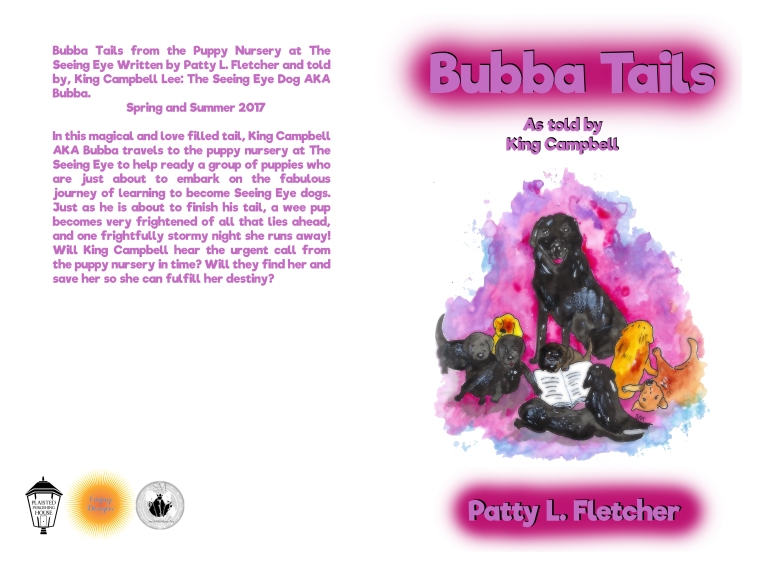
The book is, ‘Bubba Tails From the Puppy Nursery At The Seeing Eye’
In Bubba Tails From the Puppy Nursery At The Seeing Eye, it is King Campbell Super Seeing Eye Dog A.K.A Bubba’s turn to tell his tale.
While helping to ready a group of pups to go and meet their puppy raiser families, so they too, might one-day become Seeing Eye dogs, he tells of what it was like for him, to grow up and become a Seeing Eye dog.
As he speaks to the wee pups, he speaks about the importance of facing one’s fears, of honesty and how telling the truth no matter how hard, is always best. He speaks of love, faith and of believing in one’s self
Because Campbell and I are together I feel it is important for you to know him as well.
WHO IS CAMPBELL AND FROM WHERE DOES HE COME…?
Campbell was born in Chester N.J. November 28, 2008.
He lived with his Dog Mother and Litter Mates until he was approximately eight weeks old, and then he went to live with his Puppy Raisers.
Then, when he was just over a year-old, he was taken away from his Puppy Raiser family, to be trained at The Seeing Eye.
After only four short months he was chosen to become the guide of his now human mother Patty L. Fletcher.
One more important thing we must add, because of The Seeing Eye being the first ever school of this kind and due to its continuing to be the largest and oldest school in the world, before we continue, we’re obligated to post the following information. We’d love it if you’d visit the site sometime to learn all about how this wonderful Guide Dog movement began and what it takes to continue today.
Legal Notes THE SEEING EYE® and SEEING EYE® are registered trademarks of The
What do you think the publishing world needs to do more of in order to meet the needs of those who are differently-abled/disabled?
I must say I am quite pleased to have an opportunity to answer this question. Being a multiply disabled writer most certainly can be extremely challenging. So much so that I wrote an article about it. Which, I might add was well received by many in the self-publishing world. If readers would like to have a look they may visit: https://campbellsworld.wordpress.com/2018/02/07/challenges-of-a-disabled-writer/.
In the article which was also published in the Indie Publishing Magazine, I talk about the various challenges disabled writers face. Things such as:
- Photos, Screenshots, and Memes which have no descriptive text.
- The challenges of correctly dealing with words which sound the same and are spelled different, and:
- Books that aren’t TTS (Text To Speech) enabled, websites that aren’t accessible to those using screen reader or voice over technology, and lots of other things the general writing world just doesn’t consider when dealing with writers who have special needs.
I must say the next question you ask is my favorite and comes to me at a time in my life when I find daring to be different whether by design or choice is hard as the devil to do.
You ask:
What do you think the world in general needs to do in order to understand the needs of those who are differently-abled/disabled?
The best way I can answer this is this…
Be open minded. Don’t put people into boxes. I’m a multiply disabled person. I think, act, and work differently than anyone else.
But.
That’s not all due to my disability and I see a lot of this going on.
The world needs to be more accepting of things that aren’t the “Traditional way of doing things.”
One of the biggest reasons I gravitated to Indie Publishing and especially blogging was so that I could go my own way, do my own thing and be OK doing so but of late I don’t seem to fit in.
Honestly, it’s starting to seriously drag me down. Seems like no matter where I go or what I do someone somewhere disapproves.
Well, to be blunt I’m quite tired of it. No two people are the same. We’re all “differently abled” All of us no matter who we are have things that are hard for us. If people stopped and seriously took a good, long, look at themselves they’d realize that no one is without some kind of disability and I just get tired of there being all these pigeonholes that I’m supposed to fit into.
I just want to be allowed to be myself, write in a way that makes me happy, tell my stories in a way that feels comfortable to me and not have all these other people telling me what I should and should not do.
I am not them and they’re not me. They don’t live my life and I don’t live theirs.
I am a 51-year-old totally blind woman who suffers from other types of disorders as well and these disorders cause me to think, feel, and process life around me in a way that is unique to only me.
But.
Is that not true of everyone? Do we not all deal with life as it comes to us in a different way? If you read something and I read that same thing are we both going to receive the very same message?
If you choose one way to put your work out there for the world to enjoy and I choose another is your way any better than mine?
I guess I’m just tired of the “world” thinking it knows what’s best for me.
I’ve a favorite affirmation it goes like this…
“The world is not perfect, so there-for I need not be perfect.”
If I were to sum it all up into one word it would be, ‘allow’
‘Allow’ me to be who I am. ‘Allow’ yourself to be who you are.
In closing let me share these words a dear friend once wrote to me during a time in my life when I was doubting my ability to succeed. He wrote…
“Patty,
Congratulations on your success! Yes, success. All successful people (writers are people too!) get criticized – a lot. There is an entire industry based on criticizing books, movies, plays, sports, cars, etc.… the list goes on forever.
Don’t let the criticism get to you. You put in the work, you made it happen – only you get to decide if it turned out the way you intended. No one else is qualified. Forge ahead, do what is in your heart, write your books, sing your songs, dance your dance – be you. Everyone else can worry about being themselves!”
Thank you very much for this opportunity to speak about myself and what it is to be a disabled writer in a world in which it can at times be hard to work and belong in.
~~~~~~~~~~~~~~~~~~~~~~~~~~~~~~~~~~~
Thank you, Patty!

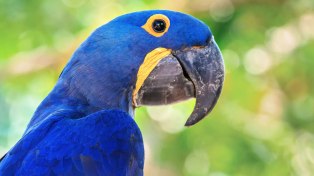 Considering Alex the Parrot and Koko the Gorilla, and other species: crows are problem solvers and remember faces. We discussed dogs, cats, and others. Is love, as an abstract idea, understood and applied by animals? And then – is intelligence found in showing love?
 I’ve written so many stories from first person point of view. At first, I was nervous because people did ask – is that real? is that you? and even contacted me and said – I know that’s about you.
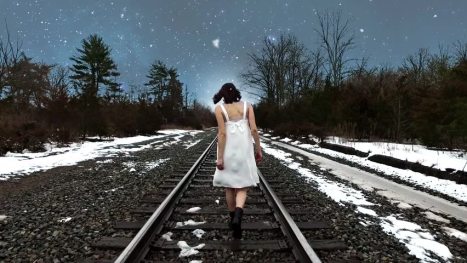 from someone who believed they knew me thought it wasn’t a realistic portrayal of me. I had to tell him because the character was not me! While the same story convinced another person that I’d led a secret life prior to moving to California.
 Many years ago,
  done. I was concerned what readers might think – that this might serve as some sort of legacy I couldn’t live down.
 I didn’t hear from any of them again. But they did put a tiny little line in an inconspicuous place on their website that the story was mislabeled as memoir and should read fiction.


 Although one website says it’s a good book for beginning writers, I think we might all find some inspiration in these pages.
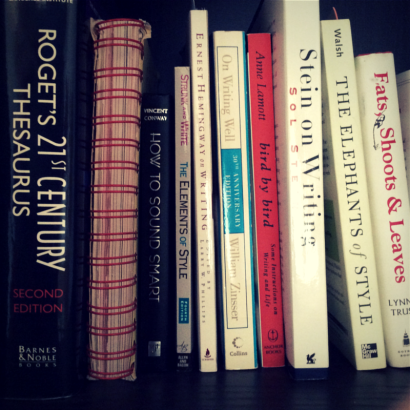 I began browsing my bookshelf, which is semi-organized: books I’ve read and loved. Books I want to read. School books. Writing books. and, of course, Poe books

 Write what scares you…..
 Do you feel the need to have a certain, special place to write? Maybe you have little items you feel inspire you sitting around your desk, computer, in the same room, maybe there is a stone of carnelian or citrine to spark creativity, or even big dark shades to hide you from the world.
 Brown. However, if he gets up at 4 a.m. to write (as he states), who is doing laundry at that time? And, if the laundry was put in later, then obviously someone came in to disturb you. And, by that time, he couldn’t move to another room? Okay, sorry, sorry. Back to the point.

 Noreen Lace
You must be logged in to post a comment.